
The Core Difference: Intent vs Attention
Google Ads shows your ads to people who are searching for something. They’ve already told Google what they want.
Meta Ads shows your ads to people while they scroll. They weren’t looking for you, so your ad has to earn their attention.
In simple terms:
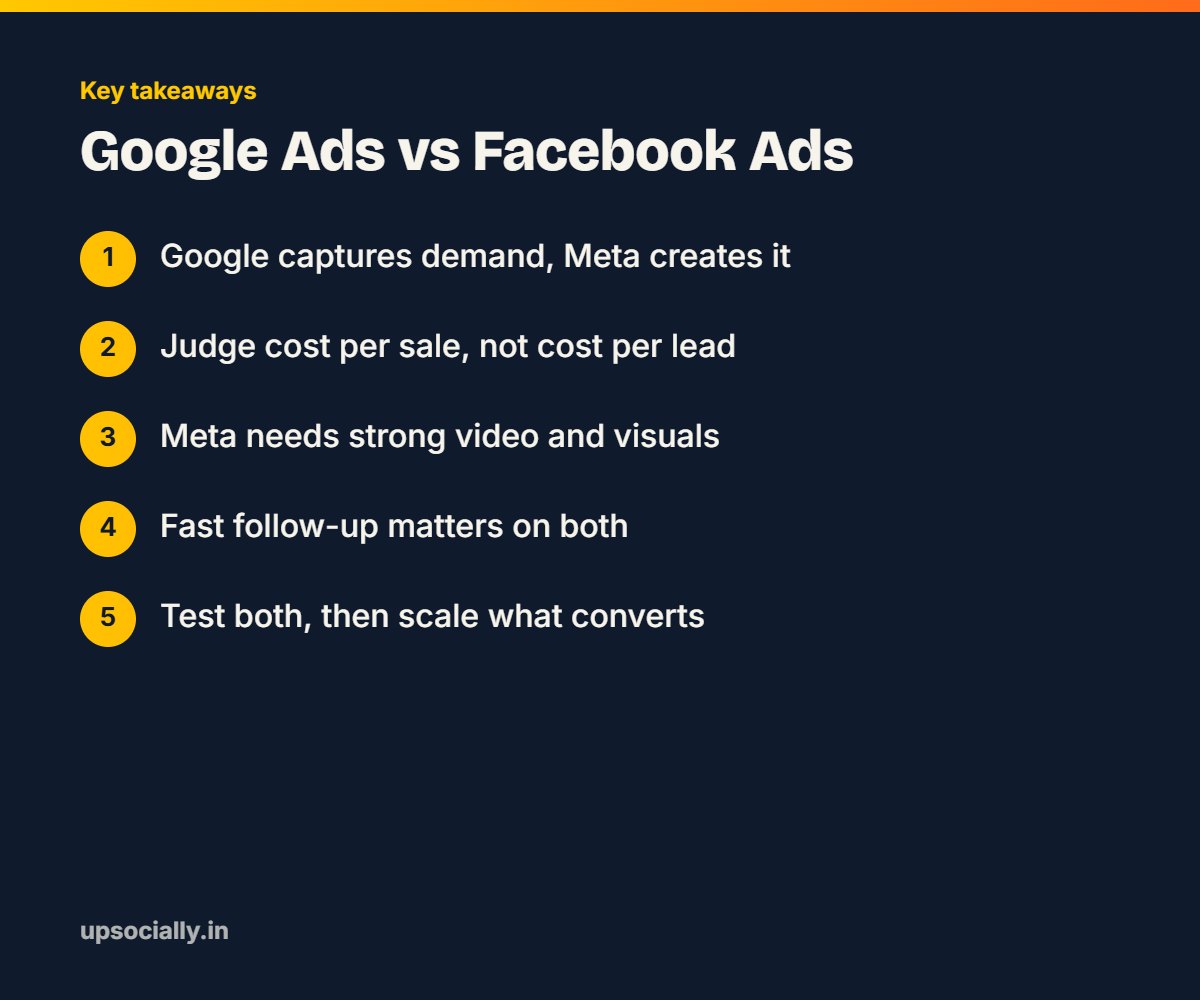
- Google captures existing demand.
- Meta creates new demand.
Google Ads vs Facebook Ads: 7 Key Differences
| Factor | Google Ads | Facebook and Instagram Ads |
|---|---|---|
| Buyer intent | High: people are actively searching | Lower: people are browsing |
| Targeting | Keywords, location, device, audience signals | Location, interests, behaviour, lookalike audiences |
| Typical cost per lead | Often higher | Often lower |
| Lead quality | Often more ready to act | Mixed; often earlier in the decision |
| Creative | Text ads and landing pages matter most | Images and video matter most |
| Scale | Limited by how many people search | Can reach large audiences quickly |
| Best for | Urgent or high-intent needs | Visual, aspirational or new products |
1. Intent and Lead Quality
Someone searching “dental implant cost in Indiranagar” is much closer to booking than someone who scrolled past an implant video on Instagram.
That’s why Google leads often convert better, even when they cost more. Meta leads can still be excellent, but they usually need more education and follow-up.
2. Cost: Look Beyond Cost per Lead
Comparing the two platforms on cost per lead alone is misleading.
| Example | Meta | |
|---|---|---|
| Leads | 50 | 150 |
| Qualified leads | 30 | 45 |
| Sales | 6 | 6 |
In this illustrative example, Meta delivers three times the leads, but both produce the same number of sales. If Meta also costs less in total, it wins. If your sales team spends twice as long on Meta leads, the picture changes. Always compare cost per sale and the time your team spends.
3. Targeting
Google targets what people search for, where they are and signals about them. Meta targets who people are and what they’re interested in, and can find new audiences similar to your existing customers.
For local businesses, both platforms let you target specific areas, which keeps budgets focused.
4. Creative Requirements
Google search ads are mostly text, so your keywords, ad copy and landing page do the heavy lifting.
Meta is visual. Without good images or short videos, your ads will struggle. Real photos and videos of your work almost always beat stock images.
5. Speed and Scale
Google is limited by search volume. If few people search for your service, you can’t buy more searches.
Meta can reach many people quickly, which helps when you’re launching something new or when people don’t yet know to search for you.
6. Sales Cycle and Follow-Up
Meta lead forms make it very easy to enquire, which brings volume but also less-serious leads. Adding qualifying questions to the form helps.
For both platforms, speed matters. A lead called within minutes is far more likely to convert than one called the next day.
7. Tracking and Measurement
Both platforms optimise better when they know which leads turned into customers. Track form submissions, calls and WhatsApp clicks, and if possible feed qualified leads and sales back to the platforms.
Which Platform Suits Your Industry?
| Industry | Usually start with | Why |
|---|---|---|
| Real estate | Meta, then add Google | Visual projects and large audiences; Google for high-intent project searches |
| Schools | Both | Google for “schools near me”; Meta for awareness among parents |
| Healthcare and clinics | Google profile and search, carefully | High-intent searches; NMC and Dental Council rules limit promotional content |
| Construction and B2B | Google, plus LinkedIn | Searches show clear intent; Meta suits residential projects |
| Interior design | Meta, then Google | Highly visual; Google for area-based searches |
| E-commerce | Both | Meta for discovery; Google for product searches |
For healthcare specifically, read our guide to digital marketing for doctors before running any ads.
Landing Pages and Lead Forms
Whichever platform you choose, what happens after the click decides your results.
Landing pages
- Match the page to the ad: same offer, same words, same visuals
- Put the key information and call to action near the top
- Keep forms short, with only the questions you really need
- Add WhatsApp and click-to-call for people who prefer to talk
- Make sure the page loads fast on mobile
Meta instant forms
Instant forms open inside Facebook or Instagram and pre-fill details, which increases volume. To improve quality, add a review step and one or two qualifying questions, such as budget or timeline.
Common Mistakes to Avoid
- Judging platforms on cost per lead instead of cost per sale
- Sending all traffic to the homepage
- Using stock images on Meta
- Broad keywords on Google with no negative keywords
- Calling leads back hours or days later
- Not tracking which leads became customers
A Simple Way to Test Both
- Define a qualified lead and a sale before you start.
- Set up tracking for forms, calls and WhatsApp on both platforms.
- Split a test budget between Google and Meta for a few weeks.
- Use dedicated landing pages for each campaign.
- Follow up every lead quickly and record the outcome.
- Compare cost per qualified lead and cost per sale, not just cost per lead.
- Move budget towards what converts, and keep testing.
Using Both Together
For many businesses, the best answer to Google Ads vs Facebook Ads is “both, in the right roles”:
- Meta builds awareness and reaches people before they search
- Google captures them when they’re ready
- Meta retargets website visitors who didn’t enquire
Final Thoughts
Google Ads is usually the better starting point when people already search for what you offer. Meta is usually better when your product is visual, new or needs demand created. The winner for your business is whichever brings sales at an acceptable cost, and the only reliable way to know is to test and track properly.
Related reading: SEO vs Google Ads: which should your business invest in first?
See our paid media services, read our guide to digital marketing cost in India to plan your budget, or explore lead generation for construction companies and real estate.
Frequently Asked Questions
Is Google Ads or Facebook Ads better for lead generation?
Neither is better for every business. Google Ads usually brings higher-intent leads because people are actively searching. Facebook and Instagram ads often bring cheaper leads at a larger scale, but they may need more follow-up and nurturing.
Which is cheaper, Google Ads or Facebook Ads?
Facebook and Instagram ads often have a lower cost per lead, while Google Ads often has a higher cost per click and per lead. The better measure is cost per sale, which depends on lead quality and your follow-up.
Should I run Google Ads and Facebook Ads together?
Often, yes. Many businesses use Meta to build awareness and retarget visitors, and Google to capture people who are ready to act. Start with one, prove it works, then add the other.
What is the main difference in Google Ads vs Facebook Ads?
Google Ads targets intent: what people are searching for right now. Facebook Ads targets people: their location, interests and behaviour, often before they start searching.
How much should I spend to test Google Ads vs Facebook Ads?
Set a test budget large enough to get meaningful data on each platform over a few weeks, track every lead through to sale, and compare cost per qualified lead and cost per sale before scaling.