
What Digital Marketing for Doctors Should (and Shouldn’t) Do
Good healthcare marketing helps patients find the right care and make informed decisions. It shouldn’t pressure, mislead or promise outcomes.
The NMC’s Guidelines on Ethical Advertising and Public Communication, issued on 6 October 2026, make this explicit. In short:
| Focus on | Avoid |
|---|---|
| Health education and public awareness | Soliciting patients or promoting your personal practice |
| Factual information: services, timings, location, fees | Testimonials, success stories and before-and-after photos |
| Qualifications and registration details | “Best doctor”, “100% success” and other unverifiable claims |
| Accurate, reviewed medical content | Discounts, coupons and limited-time offers |
| Clearly labelled AI-assisted content | AI-generated patients, voices or outcomes |
We cover the rules in detail in our guide to social media rules for doctors in India. The rest of this guide focuses on what you can do well.
Step 1: Build a Website That Answers Patient Questions
Your website is the foundation of your online presence. It’s where Google, AI search tools and patients all form an opinion of your practice.
A good doctor or clinic website includes:
- Doctor profiles with qualifications, registration number, experience, languages and timings
- Service pages explaining conditions treated and procedures offered, in plain language
- Practical information: location, parking, insurance accepted, fees and how to book
- Online booking or a clear booking route, plus WhatsApp and phone
- Consent on every form and a clear privacy notice
- Fast loading on mobile, where most patients will visit
We explain the full build in our healthcare website development guide.
Step 2: Complete Your Google Business Profile
For searches like “dermatologist near me” or “paediatrician in Koramangala”, the map results are often the first thing patients see.
- Choose the correct primary category for your specialty
- Add accurate timings, including holidays
- Upload real photos of your clinic, reception and team
- List your services clearly and factually
- Respond to reviews politely, without revealing any patient information
The NMC guidelines prohibit soliciting, buying or manipulating reviews. Let reviews come naturally from patients, and never offer anything in exchange for them.
Step 3: Use SEO to Answer What Patients Search
Patients search for symptoms, conditions and procedures long before they search for a doctor. Helpful, accurate content meets them at that stage.
- “What causes recurring migraines?”
- “When should I see a doctor for knee pain?”
- “What to expect during a colonoscopy”
- “Is PCOS treatable?”
Write clear, reviewed answers, name the doctor who reviewed the content, and update it regularly. This kind of content is also what AI answer engines like Google’s AI Overviews and ChatGPT tend to cite.
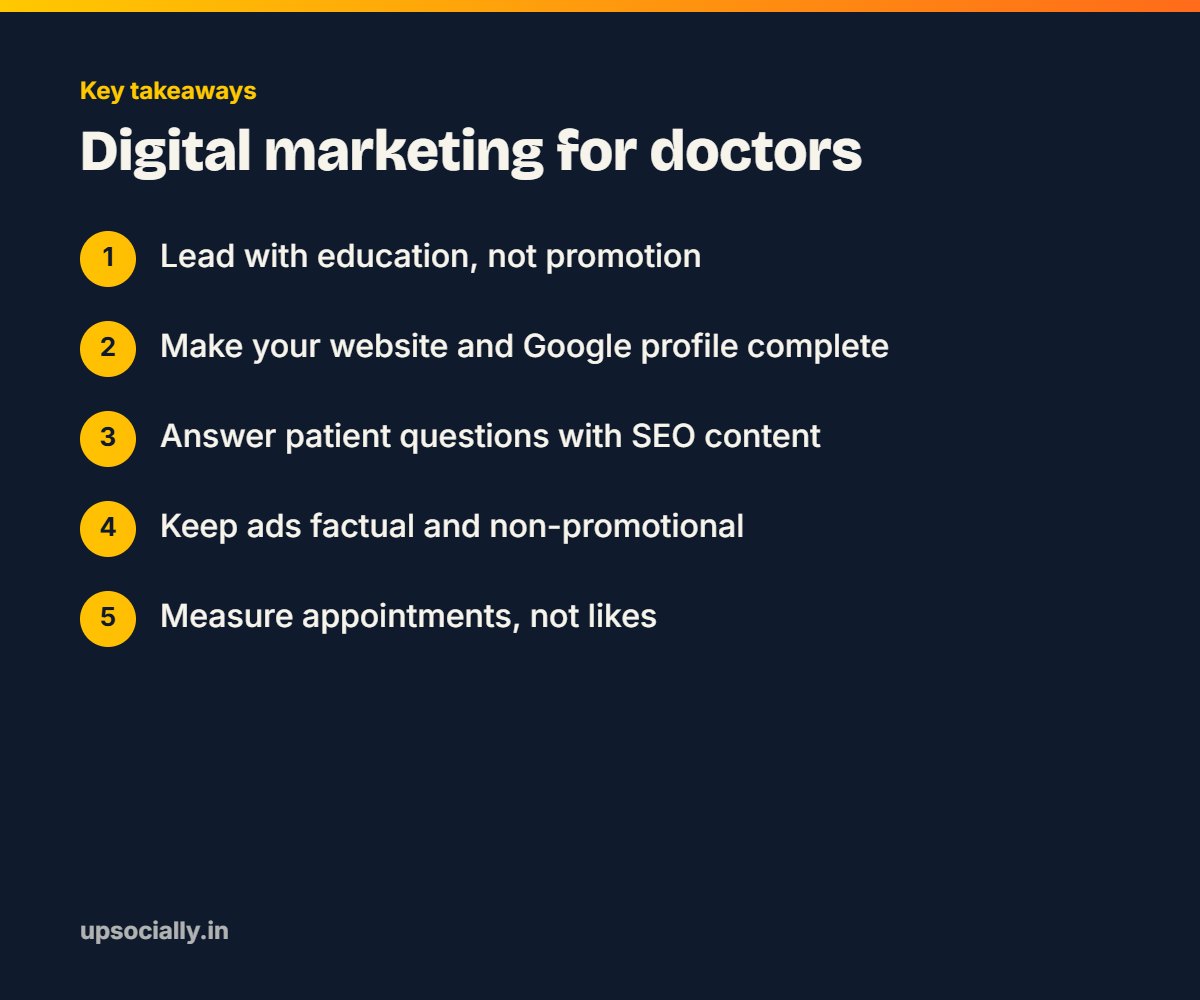
Step 4: Use Social Media for Education
Social media still works for doctors, as long as the purpose is education rather than promotion.
- Short explainer videos on common conditions
- Myth-versus-fact posts
- Seasonal health advice
- Health awareness days
- Q&A sessions on general topics
Avoid patient stories, testimonials and any post that mainly exists to bring patients to you. Show your name, qualifications and registration number with your posts.
For hospitals and multi-doctor clinics, see our healthcare social media marketing service.
Step 5: Use Paid Ads Carefully, If at All
The 2026 guidelines don’t name individual ad platforms, but they apply to all advertising and promotion, including sponsored posts. They prohibit solicitation, unverifiable claims, inducements and payments linked to procuring individual patients.
If you do run ads:
- Keep the content factual: services, location, timings and booking information
- Avoid superlatives, guarantees, discounts and patient stories
- Don’t pay any agency or platform per patient acquired
- Check with your State Medical Council or legal adviser first
Many practices find that a strong website, Google profile and educational content bring enough patients without paid ads.
Step 6: Make Booking and Follow-Up Easy
Even the best marketing fails if patients can’t get through.
- Answer calls and WhatsApp messages promptly during clinic hours
- Offer online booking where possible
- Send appointment reminders to reduce no-shows
- Keep medical conversations off public channels
Step 7: Keep Directory Listings Accurate
Many patients also find doctors through healthcare platforms and directories. Make sure every listing shows the same accurate details: name, qualifications, registration number, clinic address, timings and fees.
Under the NMC’s 2026 guidelines, healthcare platforms must not offer paid rankings of doctors, and doctors must not pay to manipulate rankings or reviews. Focus on complete, accurate listings rather than paid placement.
Build your professional reputation the right way
- Publish or co-author articles in recognised medical journals
- Speak at medical conferences and CME programmes
- Give public health talks on TV, radio or online in your own name
- Take part in government health campaigns and awareness programmes
These activities build genuine authority, which also helps Google and AI search tools recognise you as a trustworthy source.
Step 8: Measure What Matters
| Metric | What it tells you |
|---|---|
| Appointment bookings | Whether your online presence is bringing patients |
| Calls and WhatsApp enquiries | Which pages and channels drive contact |
| Google Business Profile actions | How patients find you on maps |
| Organic search traffic | Whether your content is being found |
| Review rating and volume | How patients perceive your care |
Priorities by Practice Type
| Practice | Priorities |
|---|---|
| Solo doctor or consultant | Google profile, simple website, educational content in your specialty |
| Specialist clinic | Service pages, doctor profiles, local SEO, factual booking information |
| Multispecialty hospital | Department structure, doctor directory, governance and approval workflow |
| Diagnostic centre | Test information, home collection, timings and reports access |
Common Mistakes to Avoid
- Posting patient testimonials or before-and-after photos
- Using words like “best”, “guaranteed” or “painless”
- Running discount offers on treatments
- Paying agencies per patient or per appointment
- Leaving the Google profile incomplete or outdated
- Publishing AI-generated content without medical review or labelling
Final Thoughts
Digital marketing for doctors in 2026 is about trust, not tricks. Be easy to find, be accurate, educate generously and make booking simple.
That approach fits the NMC’s new guidelines, and it’s also what patients want.
See our pages on hospital marketing in Bangalore and healthcare social media in Chennai, or browse our healthcare and pharma marketing FAQs.
Frequently Asked Questions
Is digital marketing allowed for doctors in India?
Yes, within limits. Doctors can publish non-promotional health education, factual practice information and specific announcements. The NMC’s October 2026 advertising guidelines prohibit soliciting patients, testimonials, before-and-after images, guarantees, inducements and misleading claims.
What is the best digital marketing for doctors?
For most practices, the strongest foundation is a fast, factual website, a complete Google Business Profile, helpful educational content and a clear way to book. Social media and ads can support this if they stay educational and factual.
Can doctors run Google Ads or Facebook Ads?
The NMC guidelines don’t ban advertising channels outright, but they prohibit promotional content, solicitation, unverifiable claims and payments linked to procuring individual patients. Any ads should be factual and informational. Check with your State Medical Council or legal adviser before running paid campaigns.
How long does digital marketing for doctors take to show results?
A complete Google Business Profile and better website can improve enquiries within weeks. SEO content usually takes several months to build momentum, and the results compound over time.
Can a doctor hire a digital marketing agency?
Yes, but the doctor remains responsible for content they authorise, and agency payments must not be linked to procuring individual patients. Choose an agency that understands the NMC guidelines and builds medical review into its process.