
What Changed in October 2026?
On 6 October 2026, the NMC’s Ethics and Medical Registration Board issued the Guidelines on Ethical Advertising and Public Communication for Registered Medical Practitioners and hospitals or medical institutions. They came into force immediately.
Before this, doctors relied mainly on the 2002 code of conduct, which banned soliciting patients but said little about Instagram, YouTube, influencers or AI. The NMC’s 2023 professional conduct regulations, which had covered some of this, were put on hold within weeks of being notified.
The 2026 guidelines fill that gap. They were framed in light of a Supreme Court case on medical advertising and the existing 2002 regulations, and they are read together with the National Medical Commission Act, 2019. You can read a copy of the guidelines and a detailed summary from Medical Dialogues.
Who the guidelines apply to
- Registered medical practitioners, for any advertising, publicity, digital communication or promotion.
- Hospitals and medical institutions, alongside the clinical establishments law that applies in their state.
- Content made by others on your behalf. Using an agency, influencer or platform does not shield a doctor or institution from responsibility for content they authorised, sponsored or knowingly permitted.
The Social Media Rules for Doctors in India at a Glance
Here’s a quick summary of what the 2026 guidelines allow and prohibit on social media and other digital channels.
| Allowed | Not allowed |
|---|---|
| Non-promotional health education and public awareness | Soliciting patients, directly or through third parties |
| Factual announcements: starting a practice, change of address, temporary absence, fees | Promotional testimonials, success stories and celebrity patients |
| Hospitals sharing verifiable facts: location, departments, facilities, accreditation, charges | Before-and-after photos, even with patient consent |
| Public health talks on TV, radio or online in your own name | “Guaranteed cure”, “100% success”, “painless” and unverifiable “best” or “No.1” claims |
| Hospital doctor directories with qualifications and registration details | Discounts, coupons, cashbacks or limited-time offers that encourage unnecessary care |
| Clearly labelled AI-assisted content that is accurate | AI-generated patients, voices, testimonials or outcomes |
| Case studies published in reputed medical journals | Buying followers, likes, reviews or search rankings |
What Doctors Can Still Post on Social Media
The guidelines don’t ban doctors from social media. They change its purpose: from promotion to public information.
- Health education: what a condition is, early warning signs and when to see a doctor.
- Myth-busting: common misconceptions explained in plain language.
- Prevention and awareness: screening reminders, vaccination awareness and health days.
- Procedure explainers: what generally happens before, during and after a procedure, without promoting your own results.
- Practical information: timings, location, departments and how to book, kept factual.
- Government health schemes and public campaigns.
- Academic discussion with other professionals.
The guidelines also say doctors publishing posts should disclose their name, qualifications, registration status and State or National Medical Register number. Hospitals posting about their doctors should include the same details.
A useful test: would this post still be valuable if your name and clinic weren’t on it? If yes, it’s probably education. If it mainly exists to bring patients to you, it’s probably promotion.
What Is Now Prohibited
Testimonials, reviews and before-and-after images
Promotional patient testimonials, success stories and before-and-after photographs are not allowed. Importantly, patient consent does not make them acceptable. Requesting or sharing testimonials for promotion on social media is also out, and fake or paid reviews are prohibited.
Guarantees and superlatives
Claims like “guaranteed cure”, “100% success”, “painless treatment” or “best doctor in Bangalore” are prohibited. Comparative claims such as “leading” or “No.1” are only acceptable if they are objectively verifiable, with the methodology and dates disclosed where needed. The same applies to awards and rankings.
Discounts and inducements
Limited-time offers, coupons, cashbacks, referral benefits, contests or free procedures that encourage unnecessary consultations, tests or treatment are not allowed. Fees can be declared, but only factually and transparently.
Paid patient procurement
Commissions, rebates, referral fees and lead-generation fees tied to individual patients are prohibited, as are agency, influencer or platform payments linked to procuring individual patients.
Fake engagement
Buying or manipulating followers, likes, reviews, ratings, views or search rankings is prohibited. Healthcare platforms must not offer paid rankings of doctors.
Product endorsements
Doctors may not use their name, photo, voice or professional status to endorse drugs, devices or health products, whether or not they are paid.
Misleading AI content
AI may not be used to create misleading claims, or to create or manipulate patient images, voices, testimonials or outcomes. Where AI-generated promotional content is permitted, it must carry a clear label stating that it is AI-generated.
Other Laws That Still Apply
The 2026 guidelines sit alongside several other rules that affect what doctors and hospitals can post.
- The 2002 professional conduct regulations, which still treat soliciting patients and self-advertising as unethical.
- The Drugs and Magic Remedies (Objectionable Advertisements) Act, 1954, which prohibits advertisements claiming to treat a list of diseases and conditions.
- The Consumer Protection Act, 2019 and the CCPA’s guidelines on misleading advertisements.
- The Digital Personal Data Protection Act, 2023 and its 2025 Rules, which govern patient data used in forms, WhatsApp and advertising. Most consent and notice obligations apply from May 2027. See the government’s overview of the DPDP Rules, 2025.
- ASCI’s code for truthful, substantiated claims, and its influencer guidelines for disclosures.
- State clinical establishment laws, such as the Karnataka Private Medical Establishments Act, which govern hospitals and clinics. Where they conflict with the guidelines, the state or central Act prevails for institutions.
Penalties for Breaking the Rules
For doctors, State Medical Councils can take graded action after a show-cause notice and a chance to respond:
| Violation | Possible action |
|---|---|
| First violation | Warning and mandatory ethics training |
| Second violation | Censure and a monetary penalty |
| Third violation | Suspension of registration for 3–6 months |
| Serious violations, such as misleading cure claims or mass digital solicitation | Suspension for 6–12 months |
| Repeated violations | Removal from the medical register for 1–3 years |
Doctors can appeal to the NMC’s Ethics and Medical Registration Board. Hospitals face action under the clinical establishments law that applies to them, and a doctor who approved the content can be examined separately.
Personal Profile vs Clinic Page
Your professional obligations apply to every account you control, including your personal profile.
- Use your personal profile for education, public health topics and professional updates, with your registration details.
- Use the clinic or hospital page for factual information about services, facilities, timings and the team.
- Keep both free of testimonials, patient-identifying details and promotional offers.
How to Handle Comments, Reviews and Messages
- Don’t confirm someone is your patient in a public reply.
- Don’t discuss treatment details publicly. Move the conversation to a private, secure channel.
- Don’t diagnose in comments or DMs. Share general information and suggest a consultation.
- Don’t ask patients to post reviews as part of a promotion, and never buy or script reviews.
- Respond to negative reviews calmly, without revealing medical details.
A Daily Pre-Posting Checklist
Give this checklist to whoever manages your accounts. It turns the social media rules for doctors in India into a quick routine.
| Question | If the answer is “no” |
|---|---|
| Is the post educational or factual rather than promotional? | Rewrite it or don’t post it |
| Has a doctor reviewed it for medical accuracy? | Hold it until it’s reviewed |
| Is it free of testimonials, before-and-after images and success stories? | Remove that content |
| Is it free of guarantees, discounts and unverifiable superlatives? | Rewrite the claim or remove the offer |
| Does it show the doctor’s name, qualifications and registration number? | Add the details |
| Is any AI-generated content labelled, and free of synthetic patients? | Label or remove it |
| Is patient privacy fully protected? | Remove identifying details |
Content Ideas That Stay Within the Rules
- “3 signs you should see a [specialist]” short videos
- Monthly myth-versus-fact carousels
- Explainers on how a common test or procedure works
- Seasonal health advice, such as monsoon infections or heat illness
- Health awareness days and government screening schemes
- “What to bring to your first appointment” guides
- Patient education in Kannada, Tamil or Hindi alongside English
What This Means for Hospital Marketing Teams
For hospitals and multi-doctor clinics, compliance needs to be part of the workflow, not a final check.
- Audit existing content. Older posts with testimonials, before-and-after images or offers should be reviewed and, where needed, removed.
- Update your social media policy for staff and doctors.
- Assign a medical reviewer for clinical content in each department.
- Review agency contracts. Remove any payment linked to individual patients, and make sure your agency follows the guidelines.
- Keep an approval record for every post.
- Label AI-assisted content and ban synthetic patient content entirely.
This is how we run our healthcare social media marketing work, with medical review and an approval record for every clinical post.
Final Thoughts
The new social media rules for doctors in India don’t take doctors off social media. They push the focus back to what patients actually need: clear, accurate and honest health information.
Practices that lead with education, protect patient privacy and stay away from promotional shortcuts can still build trust and visibility online.
If you’re in Bengaluru or Chennai, see our pages on healthcare social media marketing in Bangalore and healthcare social media marketing in Chennai. For a wider plan, read about our work as a hospital marketing agency, and make sure your website follows the same principles with our healthcare website development service.
You’ll find more answers in our healthcare and pharma marketing FAQs.
Frequently Asked Questions
Can doctors advertise on social media in India?
Doctors can share non-promotional health education and specific factual announcements, such as starting a practice, a change of address or a public declaration of fees. Under the NMC’s October 2026 guidelines, they cannot use social media to solicit patients, promote their personal practice or monetise content through promotional marketing.
What are the NMC 2026 advertising guidelines?
They are the ‘Guidelines on Ethical Advertising and Public Communication’ issued by the NMC’s Ethics and Medical Registration Board on 6 October 2026, with immediate effect. They cover doctors and medical institutions across social media, websites, search, platforms, AI-generated content and conventional advertising.
Can doctors post patient testimonials or before-and-after photos?
No, not for promotion. The 2026 guidelines prohibit promotional testimonials and before-and-after photographs, and state that patient consent does not by itself make a prohibited testimonial permissible.
What are the most important social media rules for doctors in India?
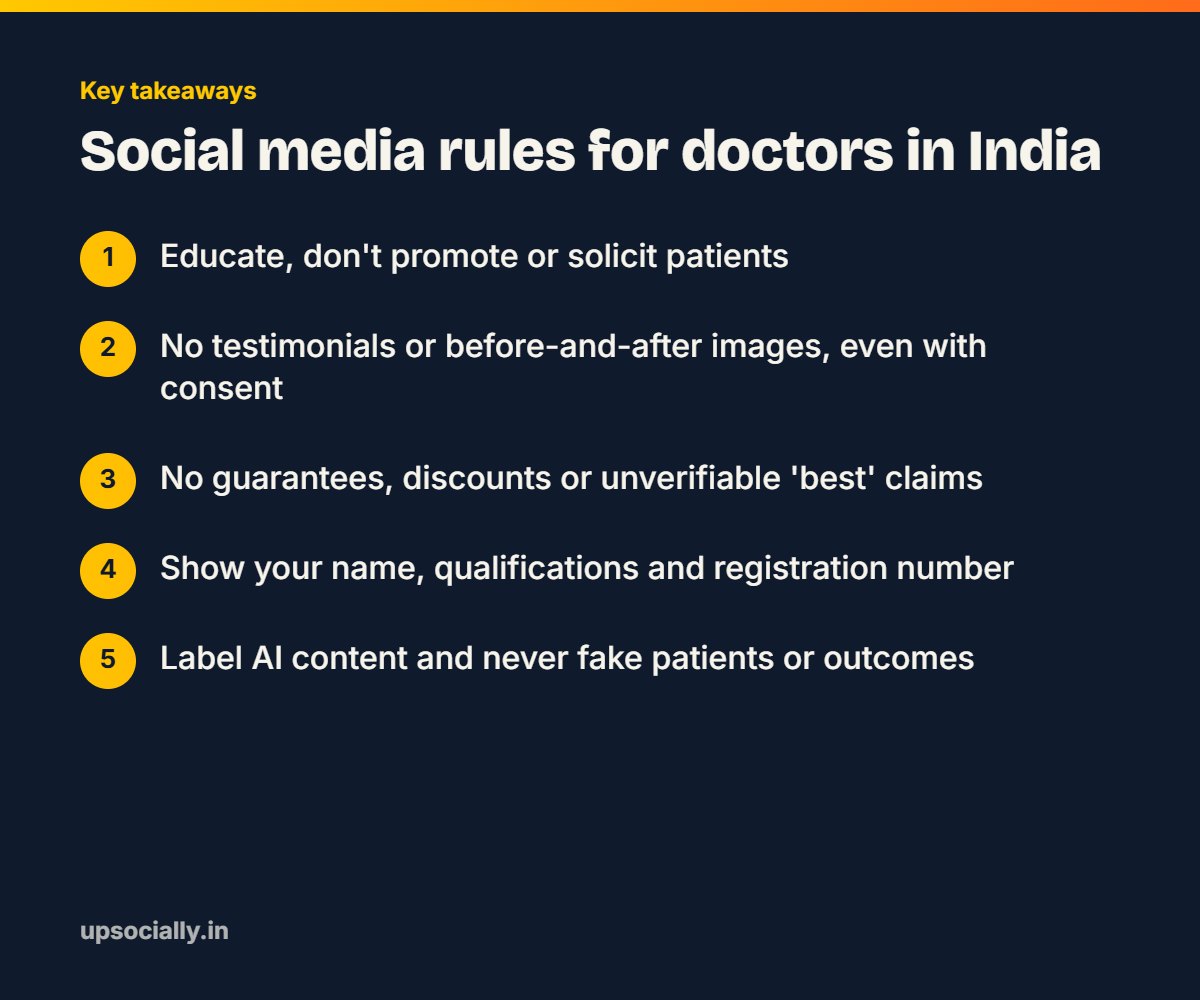
Educate rather than promote, avoid guarantees and unverifiable superlatives, never use testimonials or before-and-after images for promotion, disclose your name, qualifications and registration number, label AI-generated content and protect patient privacy.
What happens if a doctor breaks the NMC advertising guidelines?
State Medical Councils can take graded action, from a warning and ethics training to censure, a monetary penalty and suspension of registration. Repeated violations can lead to removal from the medical register for a specified period, with an appeal route to the NMC.
Can a doctor hire a digital marketing agency?
Yes, but the doctor remains responsible for any content they authorise or knowingly permit, and payment arrangements linked to procuring individual patients are not allowed. Choose an agency that builds compliance review into its process.