

What UCPMP 2024 Means for Pharma Digital Marketing in India
The Department of Pharmaceuticals notified UCPMP 2024 on 12 March 2024. It applies to pharmaceutical companies and medical device companies, and it covers promotion in any form, so digital channels are included even though the code rarely mentions them by name. You can find the code and the compliance portal on the Department of Pharmaceuticals website.
The provisions that matter most online:
- Consistency with approval: promotion must match the product’s marketing approval and can’t start before approval is granted.
- Balanced and verifiable claims: information must be accurate, up to date, balanced and capable of substantiation.
- The word “safe”: it can’t be used without qualification.
- The word “new”: it can’t be used for a product that has been available or promoted in India for more than a year.
- Comparisons: they must be fair and substantiated, without disparaging competitors or healthcare professionals.
- No gifts to healthcare professionals: including digital equivalents such as vouchers or paid subscriptions.
- CME and CPD disclosure: companies must publish details of events, speaker selection and funding on their website.
- Accountability: the company’s executive head is responsible for compliance and submits an annual self-declaration.
Complaints go to the Ethics Committee for Pharma Marketing Practices of the relevant association. Remedies include public reprimands and corrective statements in the same media as the original material, which for a digital campaign could mean a corrective post on your own channels.
Prescription vs OTC: Who Can You Talk To?
The most important line in pharma digital marketing in India is between prescription and non-prescription products.
| Product type | Public promotion | Typical digital approach |
|---|---|---|
| Prescription medicines | Not permitted to the general public | Verified HCP channels, medical affairs content, unbranded disease awareness |
| OTC medicines | Permitted within advertising rules | Consumer campaigns, search, social media, e-commerce |
| Nutraceuticals and supplements | Permitted, without disease claims | Education-led content within FSSAI and ASCI norms |
| Medical devices | Depends on the device and audience | B2B, clinician education, procurement content |
The Drugs and Magic Remedies (Objectionable Advertisements) Act, 1954 also prohibits advertisements claiming to treat a list of diseases and conditions, regardless of channel.
Why the Traditional Model Needs Digital Support
Field force remains central to Indian pharma. But it has limits that digital can help with:
- Doctor time: busy specialists see many representatives and often get the same messages repeatedly.
- Coverage: reaching doctors in smaller towns consistently is expensive.
- Crowded therapy areas: in segments like diabetes, cardiology and respiratory, many brands say similar things.
- Siloed data: call reports, webinar sign-ups and email engagement often sit in separate systems.
The goal isn’t to replace representatives. It’s to give doctors useful information between visits, on the channels they already use.
Digital Channels for Reaching Healthcare Professionals
Verified HCP portals
A secure section of your website, with registration and professional verification, lets you share product information, clinical data and resources with doctors only.
E-detailing and remote engagement
Representatives can share approved digital detail aids during visits or remotely, so doctors get consistent, approved information.
WhatsApp and email
Useful for scientific updates, event invitations and requested information, but only with consent. HCP personal data is protected under the Digital Personal Data Protection Act, 2023, and the DPDP Rules notified in November 2025 bring most consent and notice obligations into force from May 2027.
Webinars and virtual CME
Online education is popular with busy doctors. UCPMP 2024 requires disclosure of CME details on your website, and travel and hospitality can only be offered to speakers.
Suits corporate updates, scientific milestones, conference coverage and medical affairs content. It also supports employer branding for hiring representatives and scientists.
Reaching Tier 2 and Tier 3 Markets
Some of the biggest growth opportunities in Indian pharma are outside the metros. Digital programmes for these markets work better when they are:
- Mobile-first and light enough for slower connections
- Available in regional languages, such as Hindi, Tamil, Kannada, Telugu or Marathi
- WhatsApp-led, since it’s often the most used channel
- Supported by local field teams who can follow up in person
Working With Doctors as Speakers and KOLs
Doctors remain the most credible voices in healthcare. But the rules on how pharma companies work with them have tightened.
- UCPMP 2024 prohibits gifts and benefits to healthcare professionals, with limited exceptions such as speakers at CME programmes.
- The NMC’s October 2026 advertising guidelines prohibit doctors from using their name, photo, voice or professional status to endorse drugs, devices or health products, paid or unpaid.
- Consultancy must be genuine, under a written agreement, with a fee for real work.
In practice, that means scientific speaking, advisory boards and educational content are possible, but doctor-led “product promotion” on social media is not. We explain the doctor side in our guide to social media rules for doctors in India.
Disease Awareness: The Safe Way to Reach Patients
Unbranded disease awareness is one of the most effective ways to reach the public for prescription therapy areas. Good awareness content:
- Helps people recognise symptoms and risk factors
- Encourages them to consult a doctor
- Does not name, show or point to any product, directly or indirectly
- Is reviewed by your medical team for accuracy
Be careful with indirect links. A campaign colour scheme that matches a brand pack, or a landing page that leads to a product site, can turn awareness into promotion.
OTC, Nutraceutical and Wellness Brands
Products that can be advertised to consumers open up a much wider range of channels: Instagram, YouTube, search ads, marketplaces and quick commerce.
The key rules are about claims. Follow ASCI’s code and its healthcare guidelines, avoid disease-treatment claims for supplements, and make sure creators who give specific health advice have the relevant qualifications and clearly disclose paid partnerships. You can find these on the ASCI website.
We cover social channels in more detail on our page about social media marketing for pharma companies.
Build an MLR-Ready Content Library
Medical, legal and regulatory (MLR) review is often the slowest part of pharma digital work. A modular content library speeds it up without cutting corners.
- Create approved building blocks: claims with references, safety information, standard disclaimers and visual templates.
- Get each block approved once, then combine blocks into posts, emails and detail aids.
- Tag content by audience so HCP-only material never reaches public channels.
- Set expiry dates for content that relies on time-sensitive claims, like “new”.
- Keep an audit trail of who approved what and when.
Social Listening and Adverse Event Monitoring
Every pharma account that allows comments needs a process for possible adverse events.
- Monitor comments, messages and mentions daily, including weekends.
- Train moderators to recognise possible adverse event mentions.
- Route them to your pharmacovigilance team within agreed timelines.
- Reply with a pre-approved message that moves the conversation to a proper channel.
- Keep a record of every escalation.
A 90-Day Plan to Get Started
| Phase | Focus | Outputs |
|---|---|---|
| Days 1–30 | Audit and governance | Channel audit, audience map, approval workflow, adverse event process |
| Days 31–60 | Foundations | HCP portal or gated section, modular content library, consent-based contact lists |
| Days 61–90 | Launch and measure | First webinar series, WhatsApp updates, awareness campaign, reporting dashboard |
What to Measure
- HCP registrations and engagement on gated content
- Webinar attendance and completion
- Reach and engagement of awareness campaigns
- Representative follow-ups triggered by digital engagement
- OTC sales signals from search and e-commerce
- Partnership, export and distributor enquiries
- Content approval turnaround time
- Adverse events routed and response times
Common Mistakes to Avoid
- Boosting a branded post for a prescription product to a general audience
- Using “safe” or “new” without checking the code’s conditions
- Asking doctors to endorse products on their social media
- Leaving comments unmonitored over weekends
- Collecting HCP data without a clear consent notice
- Letting agencies publish without an approval record
Final Thoughts
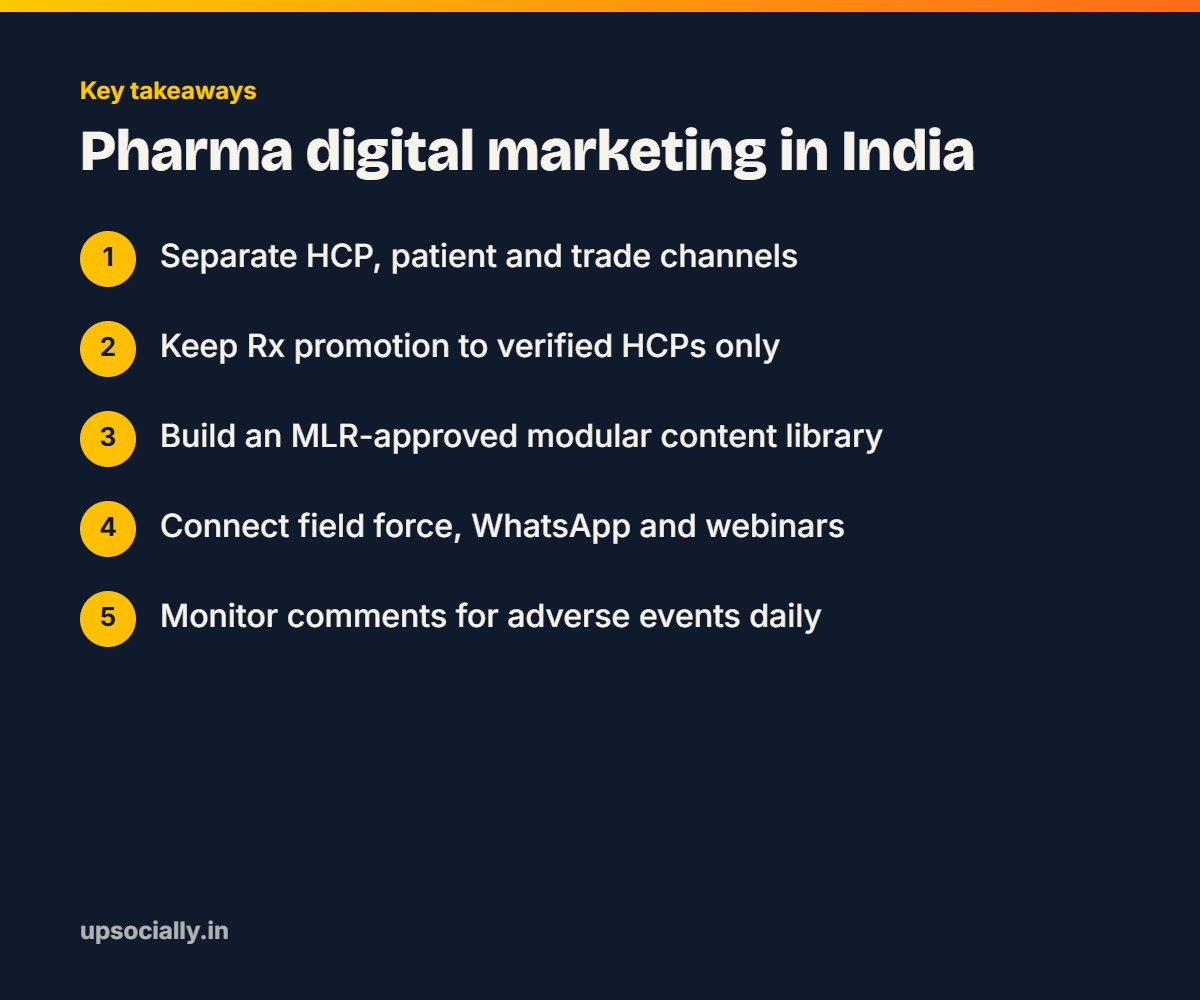
Pharma digital marketing in India works best when compliance is part of the design, not a final check.
Separate your audiences, connect digital with your field force, build a content library your reviewers trust and lead with education. That combination lets your brand stay visible to doctors and patients without creating regulatory risk.
Medical device companies face similar but different rules. See our approach to digital marketing for medical device companies. For API and CDMO businesses selling to other manufacturers, our B2B manufacturing marketing page may be more relevant.
More answers are in our healthcare and pharma marketing FAQs.
Frequently Asked Questions
Does UCPMP 2024 apply to digital marketing?
Yes. UCPMP 2024 covers promotion in any form. While it rarely mentions digital channels by name, websites, social media, email, WhatsApp, webinars and online ads are all forms of promotion.
Can pharma companies advertise prescription drugs on social media in India?
Not to the general public. Prescription products should be promoted only to healthcare professionals through appropriate, verified channels. Unbranded disease awareness can reach the public if it doesn’t point to a product.
Which channels work best for pharma digital marketing in India?
For prescription brands, verified HCP portals, LinkedIn, webinars, e-detailing and consented WhatsApp or email work well. OTC and nutraceutical brands can also use Instagram, YouTube, search ads, marketplaces and quick commerce.
Can doctors endorse pharma products online?
No. Under the NMC’s October 2026 advertising guidelines, doctors may not use their name, photo, voice or professional status to endorse drugs, devices or health products, whether or not they are paid. Scientific and educational speaking roles are different from endorsements.
Do UCPMP 2024 rules apply to medical device companies?
Yes. The code applies to both pharmaceutical companies and medical device companies.
How should pharma companies handle side effects mentioned in comments?
Treat them as possible adverse events. Monitor accounts regularly, route mentions to your pharmacovigilance team within agreed timelines and keep a record of each case.