
What Real Estate Buyers Do Before They Call You
Understanding the buyer journey is the foundation of good digital marketing for real estate.
| Stage | What buyers do | Your marketing focus |
|---|---|---|
| Awareness | Notice a project on Instagram, YouTube or a portal | Strong visuals, location benefits, launch campaigns |
| Research | Search the location, price, builder and reviews | Project website, SEO, Google profile, builder credibility |
| Shortlist | Compare floor plans, amenities and payment plans | Detailed project pages, brochures, virtual tours |
| Site visit | Book a visit, often over WhatsApp or phone | Fast follow-up, easy scheduling, reminders |
| Decision | Negotiate, check loans and paperwork | Sales team support, trust, transparency |
The Core Channels in Real Estate Digital Marketing
| Channel | Best used for | Watch out for |
|---|---|---|
| Meta Ads (Facebook and Instagram) | Launches, visual storytelling, reaching large local audiences | Low-intent leads from instant forms |
| Google Search Ads | Buyers searching for projects, locations and property types | High cost per click in competitive areas |
| SEO | Long-term visibility for locations, builder name and project searches | Takes months to build |
| Property portals | Reaching buyers already browsing listings | Shared leads and price comparisons |
| YouTube | Walkthroughs, location tours, construction updates | Needs good video production |
| WhatsApp and CRM | Follow-up, reminders, nurturing | Spammy broadcasts damage trust |
Step 1: Build a Dedicated Page for Every Project
Sending ad traffic to your homepage wastes money. Every project needs its own landing page with:
- Project name, exact location and RERA registration details
- Configurations, sizes and starting prices or price ranges
- Floor plans, amenities and specifications
- Location map with distances to key landmarks
- Real photos, renders clearly labelled as renders, and construction updates
- A short enquiry form, click-to-call and WhatsApp
Read our guide to real estate website development for a detailed checklist.
Step 2: Get RERA Compliance Right in Every Creative
The RERA Act requires that advertisements for registered projects show the project’s RERA registration number and the state authority’s website address. Several states have gone further. Tamil Nadu’s authority, for example, requires the registration number and QR code to be displayed prominently and bans vague disclaimers and travel-time claims. Always check your own state authority’s rules, such as those published by Karnataka RERA.
In practice, every ad, brochure, landing page and social post should carry the correct RERA details, and claims like “5 minutes from the airport” should be replaced with factual distances.
Step 3: Run Meta Ads for Reach and Launches
Meta is usually the fastest way to reach large numbers of potential buyers in your target areas.
- Use real visuals: site videos, walkthroughs, location footage
- Test different angles: location, lifestyle, investment, payment plans
- Add qualifying questions to instant forms, such as budget and timeline
- Retarget people who watched your videos or visited your landing page
Learn more on the official Meta Ads page.
Step 4: Use Google Ads to Capture High-Intent Buyers
Buyers searching “3 BHK apartments in Whitefield” or “villa plots near Kelambakkam” are much closer to a decision. Google Search Ads let you appear exactly when they search.
- Build campaigns around locations, property types and your project name
- Add negative keywords like “rent”, “PG” and “jobs”
- Send each ad group to the matching project page
- Track calls and WhatsApp clicks, not just form fills
Step 5: Invest in SEO for Long-Term Visibility
Paid ads stop when budgets stop. SEO keeps bringing buyers.
- Location guides: “Living in Sarjapur Road: a buyer’s guide”
- Buyer education: home loans, stamp duty, RERA checks, site visit checklists
- Project pages optimised for project name and location searches
- A complete Google Business Profile for each sales office and site
Over time, this content brings buyers who already trust you before they call.
Step 6: Fix Follow-Up Before You Increase Budgets
This is where most real estate marketing fails. A lead that waits a day for a call has usually moved on.
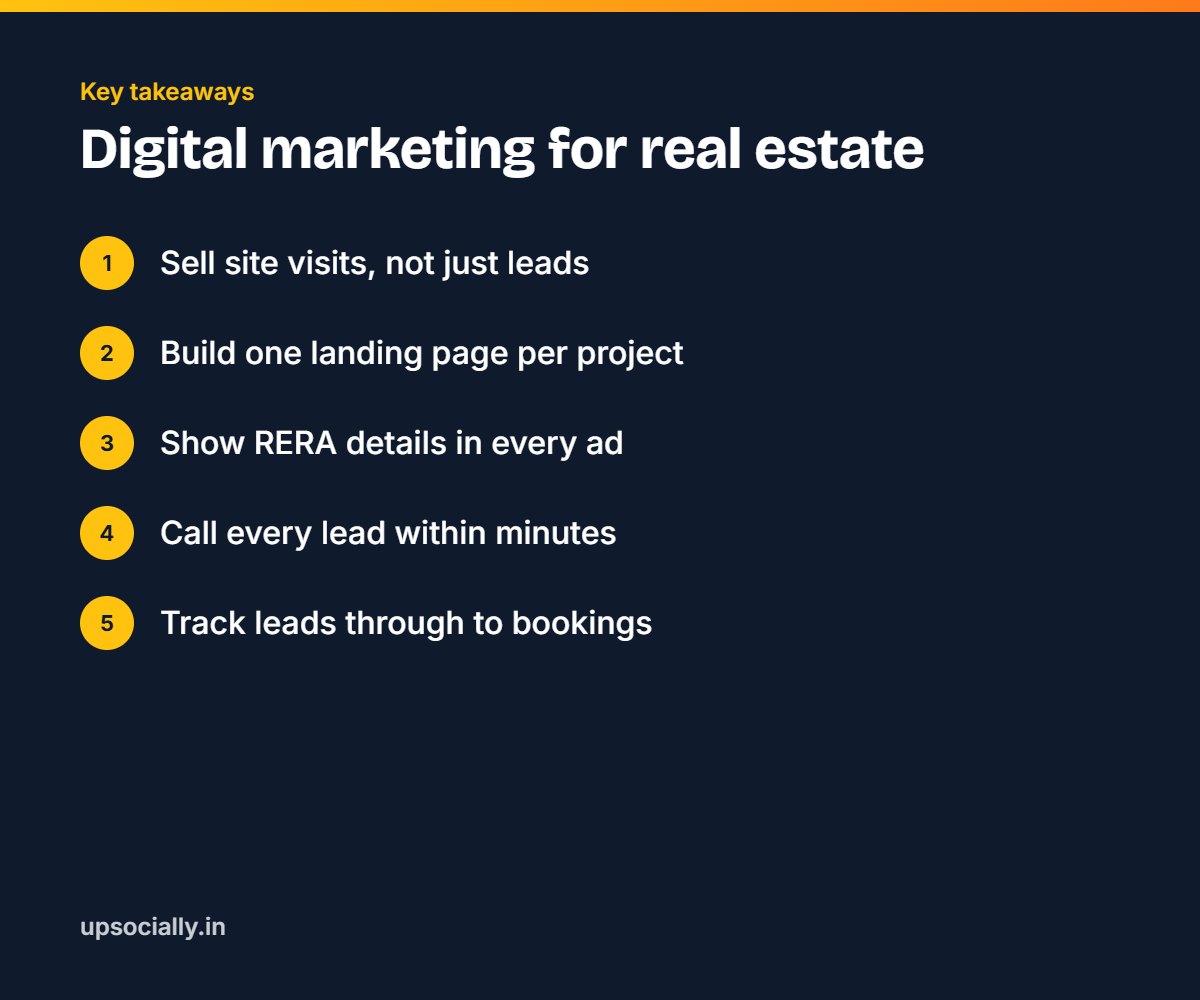
- Call every new lead within minutes during working hours
- Send an instant WhatsApp message with the brochure and location
- Qualify on budget, timeline and purpose
- Offer specific site visit slots, then send reminders
- Log every lead and outcome in a CRM
We explain this problem in depth in why real estate lead generation gets leads but no sales.
Step 7: Measure What Leads to Bookings
| Metric | What it tells you |
|---|---|
| Cost per lead | Ad efficiency, but not quality |
| Lead-to-site-visit rate | Lead quality and follow-up speed |
| Cost per site visit | The most useful day-to-day measure |
| Site-visit-to-booking rate | Sales effectiveness and project fit |
| Cost per booking | The true return on marketing spend |
Content Ideas That Work for Developers
Good content keeps your project visible between campaigns and gives buyers reasons to trust you.
- Construction updates: monthly progress videos and photos build confidence
- Location guides: schools, hospitals, offices and transport near the project
- Buyer guides: how to check RERA details, home loan steps, registration costs
- Walkthroughs: sample flat tours and amenity videos
- Handover stories: completed projects and possession events, shared with residents’ permission
Reuse each piece across your website, YouTube, Instagram and WhatsApp updates to existing leads.
A Simple Launch Plan
- Before launch: landing page, RERA-compliant creatives, CRM setup, tracking
- Launch weeks: Meta reach and lead campaigns, Google Search campaigns, walkthrough videos
- Ongoing: retargeting, construction updates, SEO content, referral campaigns
- Every week: review cost per site visit and move budget towards what converts
Common Mistakes Developers Make
- Judging campaigns only on cost per lead
- Missing or incorrect RERA details in ads
- Generic stock images instead of real project visuals
- One landing page for multiple projects
- Slow callbacks and no CRM tracking
- Stopping SEO and content once a project sells
Final Thoughts
Effective digital marketing for real estate is a system, not a single campaign: a strong project page, compliant creatives, the right mix of Meta and Google, fast follow-up and tracking all the way to bookings.
Related reading: Facebook ads for real estate: quality leads and site visits
Get the system right and every rupee of ad spend works harder.
See our city pages for Bangalore, Chennai and Coimbatore, read about Instagram marketing for builders, or compare Google Ads vs Facebook Ads.
Frequently Asked Questions
What is digital marketing for real estate?
It is the use of websites, search engines, social media, paid ads, email, WhatsApp and CRM tools to attract property buyers, generate enquiries and convert them into site visits and bookings.
Which is better for real estate: Meta Ads or Google Ads?
Most projects use both. Meta Ads reach large audiences quickly with visual creatives and suit launches, while Google Ads capture buyers actively searching for projects in a location. The right mix depends on your project, price point and budget.
Do real estate ads need a RERA number?
Yes. Under the RERA Act, advertisements for registered projects must show the RERA registration number and the website address of the state authority. Several states, including Tamil Nadu and Maharashtra, have added further rules such as QR codes.
How much should a developer spend on digital marketing for real estate?
It depends on the project size, price point and location. Many developers plan media budgets in lakhs per month during launch phases, plus agency and creative costs. Judge the budget by cost per site visit and cost per booking, not cost per lead.
Why do real estate campaigns get leads but no sales?
Common reasons include broad targeting, weak landing pages, instant forms with no qualification, slow follow-up and no CRM tracking. Fixing follow-up speed and lead qualification often improves results faster than raising budgets.