
GEO vs AEO vs SEO, in short: SEO gets your pages ranked in search results. AEO (answer engine optimization) gets your content picked as the direct answer in featured snippets, voice assistants and AI Overviews. GEO (generative engine optimization) gets your brand cited and recommended inside AI tools like ChatGPT, Gemini and Perplexity. They build on each other, and SEO is the foundation for all three.
If you run a clinic in Bengaluru, a school in Chennai or a trading business in Dubai, you’ve probably heard three acronyms in the past year: SEO, AEO and GEO. Agencies pitch them as separate services, which makes it sound like you need three budgets. You don’t. This guide explains GEO vs AEO vs SEO in plain language: what each one targets, how they overlap, and which to prioritise first. If you want one team to handle all three, our Answer Engine Optimization service is built around exactly this stack.
GEO vs AEO vs SEO: key facts at a glance
- SEO targets rankings and clicks in Google and Bing results.
- AEO targets being the extracted answer: featured snippets, “People also ask”, voice answers and AI Overviews.
- GEO targets being cited, quoted or recommended in AI-written answers from ChatGPT, Gemini, Perplexity and Copilot.
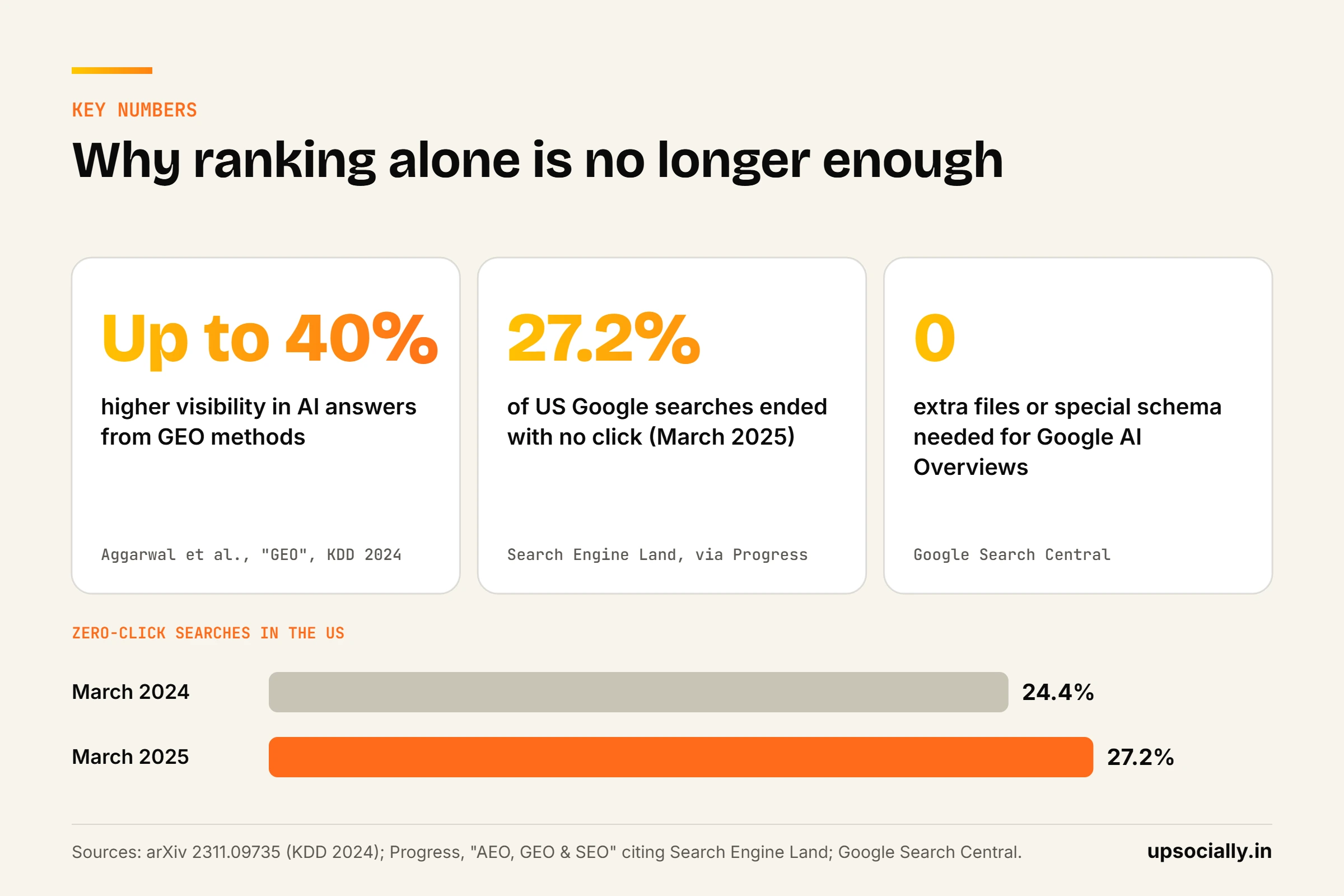
- Google says there are “no additional requirements to appear in AI Overviews or AI Mode”: a page must simply be indexed and eligible to show with a snippet.
- Research: the GEO paper accepted at KDD 2024 found that GEO methods “can boost visibility by up to 40%” in generative engine responses.
- Crawler access: OpenAI says sites that opt out of its OAI-SearchBot crawler won’t be shown in ChatGPT search answers.
What is SEO, AEO and GEO? Simple definitions
Here’s how we define each term, written so you can repeat it to your team.
What is SEO (search engine optimization)?
SEO is the practice of making your website easy for search engines to crawl, understand and trust, so your pages rank for the searches your customers type. It covers three layers: technical SEO (speed, mobile, indexing), on-page SEO (titles, headings, content that matches intent) and off-page SEO (backlinks, reviews, mentions). Success is measured in rankings, organic clicks and enquiries. Our SEO and content service covers this layer.
What is AEO (answer engine optimization)?
AEO is the practice of structuring content so a search engine or assistant can lift it out as a direct, standalone answer. Think of the box at the top of Google that answers “how much does a dental implant cost in Bangalore” without a click, or Alexa reading out an answer. AEO uses question-style headings, 40–60 word answers right below them, lists, tables and FAQ schema. Success is measured in featured snippets, “People also ask” placements and AI Overview mentions.
What is GEO (generative engine optimization)?
GEO is the practice of making your brand and content more likely to be cited, quoted or recommended when an AI tool writes an answer. The term comes from a 2023 research paper, “GEO: Generative Engine Optimization”, later accepted at KDD 2024. Unlike a search result, an AI answer blends many sources, so GEO depends heavily on what other sites say about you: directories, reviews, “best of” lists and news. Success is measured by how often AI tools name you for your buyers’ questions.
GEO vs AEO vs SEO: what’s the actual difference?
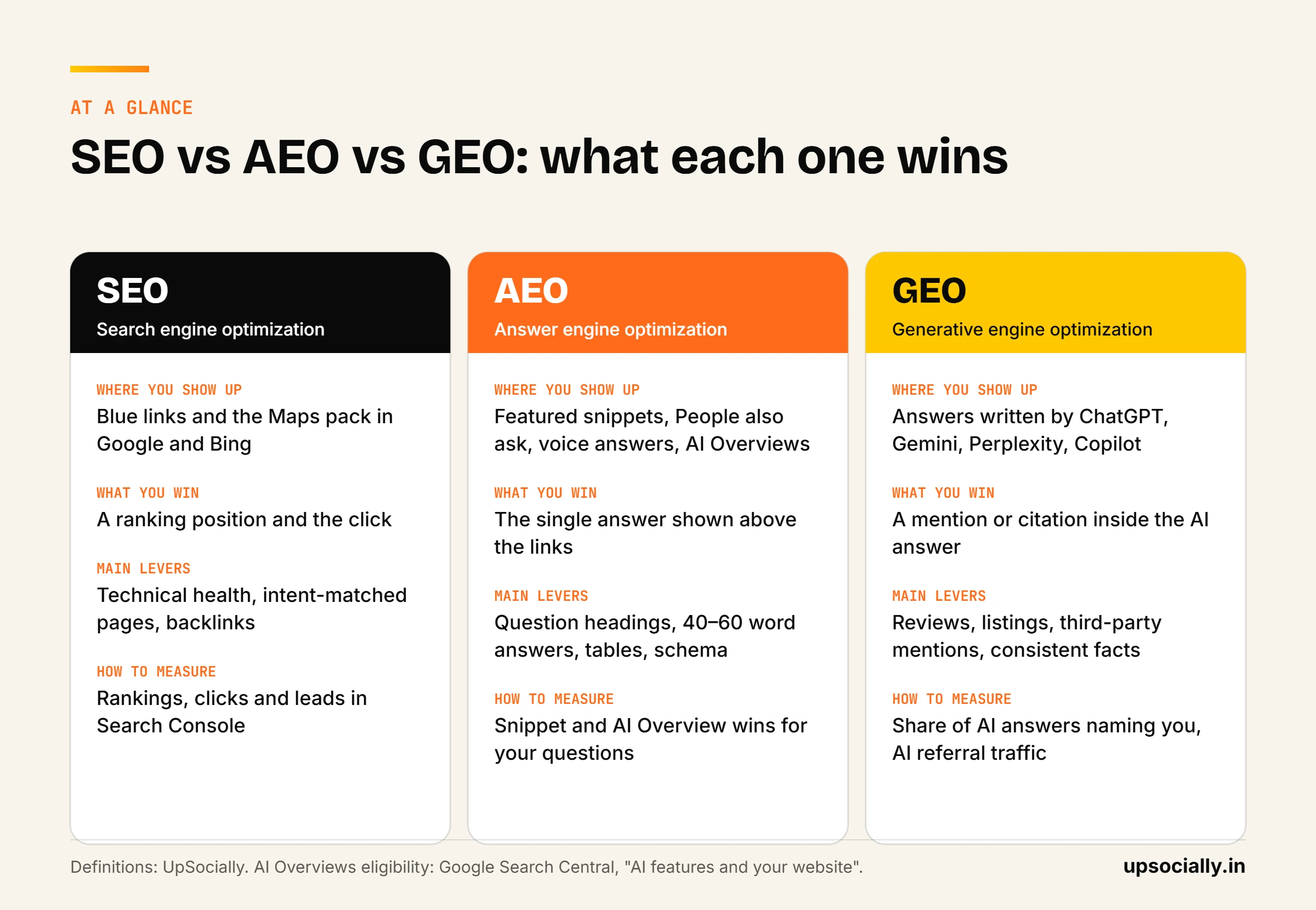
The difference is the “place” you’re trying to win. SEO wins a position in a list of links. AEO wins the single answer shown above or instead of that list. GEO wins a mention inside an answer that an AI writes from scratch. The table below compares GEO vs AEO vs SEO side by side.
| SEO | AEO | GEO | |
|---|---|---|---|
| Goal | Rank pages and earn clicks | Be the extracted answer | Be cited or recommended by AI |
| Where it shows | Google and Bing blue links, Maps pack | Featured snippets, People also ask, voice, AI Overviews | ChatGPT, Gemini, Perplexity, Copilot, Google AI Mode |
| Main levers | Technical health, intent-matched content, backlinks | Question headings, short direct answers, lists, tables, schema | Third-party mentions, reviews, consistent facts, quotable stats, crawler access |
| What gets measured | Rankings, organic clicks, leads | Snippet and PAA wins, AI Overview mentions | Share of AI answers naming you, AI referral traffic |
| Typical time to move | 3–6 months | Weeks once a page ranks on page 1 | 6–12 weeks local, 3–6 months national |
| Depends on | Itself | SEO (the page must rank first) | SEO plus reputation across the web |
Notice the last row. AEO rarely works on a page that doesn’t already rank, and GEO rarely works for a brand nobody else talks about. That’s why we treat them as layers, not alternatives.
How do SEO, AEO and GEO overlap?
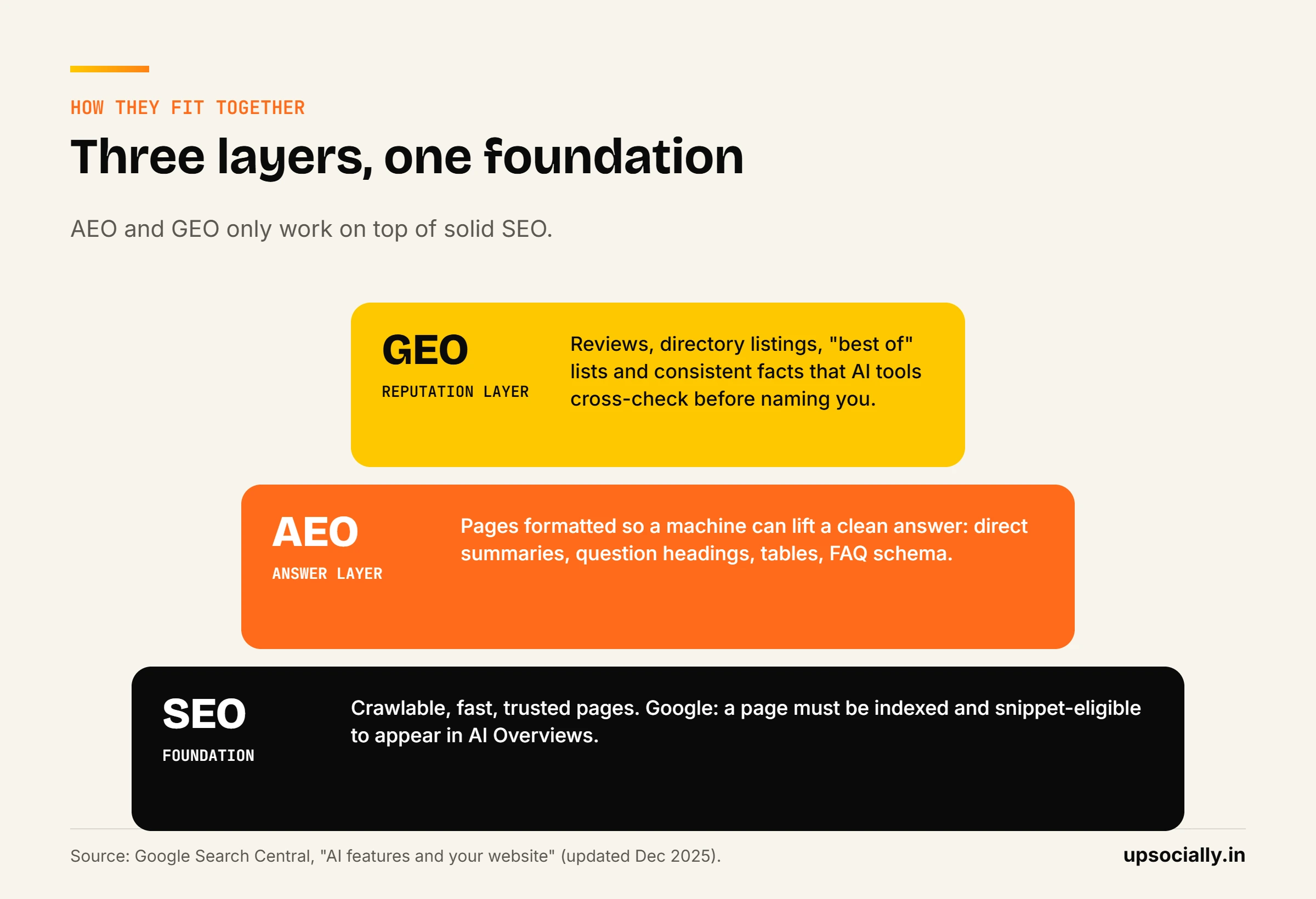
They overlap far more than agency pitches suggest. Google’s own documentation on AI features says that to appear in AI Overviews or AI Mode, “a page must be indexed and eligible to be shown in Google Search with a snippet”, and that you don’t need special files, markup or schema to qualify. In other words, Google’s AI answers sit on top of ordinary SEO.
ChatGPT works a little differently. When it searches the web, it relies on OpenAI’s own crawler and its search partners, then summarises several sources. So you need to let OAI-SearchBot read your site and be present on the pages ChatGPT trusts. We cover those steps in our guide on how to get recommended by ChatGPT.
A simple way to picture it:
- SEO makes sure machines can find and trust your page.
- AEO formats that page so a machine can lift a clean answer from it.
- GEO makes sure enough of the wider web agrees with that answer that an AI is comfortable naming you.
What does each one look like for a real business?
Take a fertility clinic in Bengaluru that wants more IVF consultations. Here’s what each discipline would actually do.
- SEO work: fix page speed on mobile, build a dedicated IVF treatment page and an IVF cost page, add internal links from the homepage, and earn mentions from health portals.
- AEO work: rewrite the cost page so the first paragraph answers “how much does IVF cost in Bangalore” in two sentences with a rupee range; add an FAQ block on success factors, timelines and eligibility; mark it up with FAQPage schema.
- GEO work: complete the Practo and Google Business Profile listings with identical details, ask happy patients for reviews within the rules, get the clinic into credible “IVF centres in Bangalore” roundups, and publish factual, PCPNDT-compliant explainers that AI tools can safely quote.
The same pattern works for a school (“CBSE school admission fees in Whitefield”), a real estate developer (“2 BHK apartments near Sarjapur Road under ₹1 crore”) or a Dubai salon (“best keratin treatment in JLT”). Each discipline answers a different part of the same buyer journey.
Which tactics move the needle for GEO?
The original GEO researchers tested content changes on a benchmark of queries and reported that the best methods could raise a source’s visibility in AI answers by up to 40%, with results that “vary across domains”. In practice, these are the GEO tactics we see matter most for Indian and UAE businesses:
- Cite specific facts and sources. Rupee ranges, timelines, regulations and named sources are easier for AI to quote than adjectives.
- Be consistent everywhere. Your name, address, phone, services and prices should match across your site, Google Business Profile, Bing Places, Justdial, Practo, IndiaMART or Clutch.
- Earn third-party mentions. AI tools lean on reviews, listicles and directories, so off-site reputation is half the job.
- Allow the right crawlers. Check robots.txt, Cloudflare and hosting settings so OAI-SearchBot, Bingbot and Googlebot aren’t blocked.
- Write entity-clear pages. State plainly who you are, what you do, where and for whom, in the first lines of each page.
What doesn’t work: stuffing pages with the phrase “best in Bangalore”, creating dozens of near-identical city pages, or paying for “guaranteed AI listings”. None of the major AI providers sell organic placement.
Is SEO dead now that people use ChatGPT?
No. SEO is the base layer that AEO and GEO stand on. Google states that AI Overviews draw on pages already eligible for search, and ChatGPT’s search reads the open web. What has changed is that ranking alone captures less of the click. Progress, citing Search Engine Land data, reports that 27.2% of US searches in March 2025 ended without a click, up from 24.4% a year earlier. So you still need SEO, but you also need to be the answer and the name that AI tools repeat.
GEO vs AEO vs SEO: which should a business prioritise first?
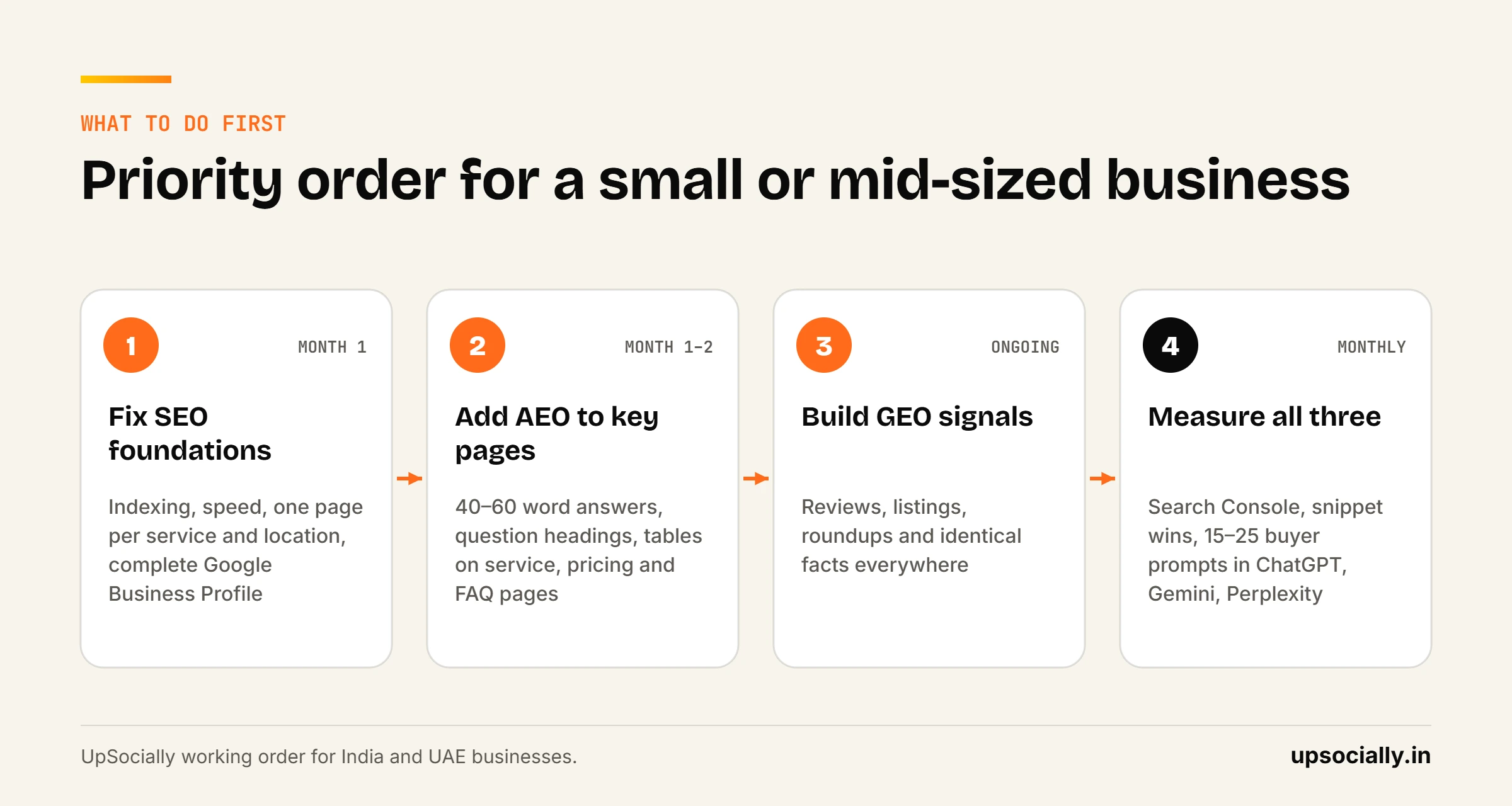
For most small and mid-sized businesses, the order is clear:
- Fix SEO foundations first. Indexing, speed, one page per service and location, and a complete Google Business Profile. Without these, nothing else sticks.
- Add AEO to your best pages. Rewrite the opening of each service, pricing and FAQ page into a direct 40–60 word answer, then add question headings and tables.
- Build GEO signals in parallel. Reviews, directory listings, roundups and consistent facts take time, so start early and keep going every month.
- Measure all three together. Track rankings in Search Console, snippet wins, and a monthly list of 15–25 buyer prompts run in ChatGPT, Gemini and Perplexity.
A local clinic or salon can usually see AEO and GEO movement within two to three months of fixing the basics. National and B2B brands need longer because third-party lists take time to earn.
How do you measure SEO, AEO and GEO?
| Discipline | Free tools | What to log monthly |
|---|---|---|
| SEO | Google Search Console, Bing Webmaster Tools | Clicks, impressions, average position for money keywords, enquiries from organic |
| AEO | Search Console, manual SERP checks | Which questions show your snippet, PAA or AI Overview mention |
| GEO | A prompt-tracking sheet, GA4 referral reports | Whether ChatGPT, Gemini and Perplexity name you; sessions from chatgpt.com, perplexity.ai and gemini.google.com |
AI answers change from run to run, so repeat each prompt two or three times and track the trend, not a single result. Indian buyers often add a neighbourhood, a budget in lakhs or a language (“Tamil-speaking dentist in Anna Nagar”), so include those variants in your prompt list.
What’s different for businesses in India and the UAE?
- Local directories carry weight. Justdial, Practo, Sulekha and IndiaMART in India, and Google Maps plus regional listings in the UAE, often appear as sources for local questions.
- Mixed-language searches. People type in Hinglish, Tanglish or Arabic-English. Use the words customers really say, including local names for services.
- Regulated categories. Doctors, IVF centres, financial advisers and builders face rules from the NMC, the PCPNDT Act, SEBI and RERA. Factual, compliant explainers are safer and more quotable than promotional claims.
- WhatsApp is the conversion step. An AI answer often leads to a WhatsApp chat or call, not a form. Track those clicks so you can see what GEO is worth.
Common mistakes when moving from SEO to AEO and GEO
- Buying separate “AEO” and “GEO” packages from different vendors with no shared plan.
- Blocking AI crawlers by accident through a security plugin or CDN setting.
- Hiding prices completely, so AI tools can’t match you to budget questions.
- Adding FAQ schema without visible FAQ content on the page.
- Checking ChatGPT once, seeing nothing, and giving up.
Frequently asked questions
Is GEO the same as AEO?
Not quite. AEO focuses on being the extracted answer in search features such as featured snippets, voice answers and AI Overviews. GEO focuses on being cited or recommended inside AI-written answers in ChatGPT, Gemini or Perplexity. The tactics overlap a lot, and many agencies use the terms loosely, but GEO leans more on off-site reputation.
Do I need separate agencies for SEO, AEO and GEO?
No. The three share the same foundations: crawlable pages, clear answers, structured data and a consistent reputation. Splitting them across vendors usually creates conflicting changes. One team that plans all three together, with one monthly report, is cheaper and faster.
Does schema markup help with AI search?
Schema helps search engines understand your page, and it powers rich results. Google says no special schema is required to appear in AI Overviews, so treat schema as good hygiene rather than a shortcut. Make sure it matches the visible content on the page.
How long do AEO and GEO take to work?
AEO can show results within weeks on pages that already rank on page one. GEO usually takes 6 to 12 weeks for local businesses and 3 to 6 months for national or B2B brands, because reviews, listings and third-party mentions build up gradually.
What is LLMO or AIO?
LLMO (large language model optimization) and AIO (AI optimization) are other names people use for roughly the same work as GEO. There’s no official standard. Focus on the outcome, being named accurately by AI tools, rather than the label.
Want one team to handle SEO, AEO and GEO?
UpSocially, a performance marketing agency in Bengaluru, India serving India, UAE and international clients, runs SEO, AEO and GEO as one plan with one report. We fix the foundations, rewrite your key pages to answer first, build your listings and reviews, and track your AI visibility every month. Explore our Answer Engine Optimization service, read the hiring an agency FAQs, or request a free AI Visibility Report to see where you stand today.
Sources: Google Search Central: AI features and your website · Aggarwal et al., “GEO: Generative Engine Optimization” (arXiv, accepted at KDD 2024) · OpenAI: Overview of OpenAI crawlers · Progress: AEO, GEO and SEO, what’s the difference (citing Search Engine Land zero-click data). Last updated: .