
Patients don’t only search for a specialty any more. They search for a doctor’s name. Before they book, they read your Google profile, watch a video of you explaining their condition and check whether your hospital profile matches what a friend told them. That online impression is your personal brand, whether or not you built it on purpose.
This guide explains personal branding for doctors in India in 2026: what it means under the NMC’s new advertising guidelines, the nine steps to build it, a 90-day plan and the mistakes that can put your registration at risk.
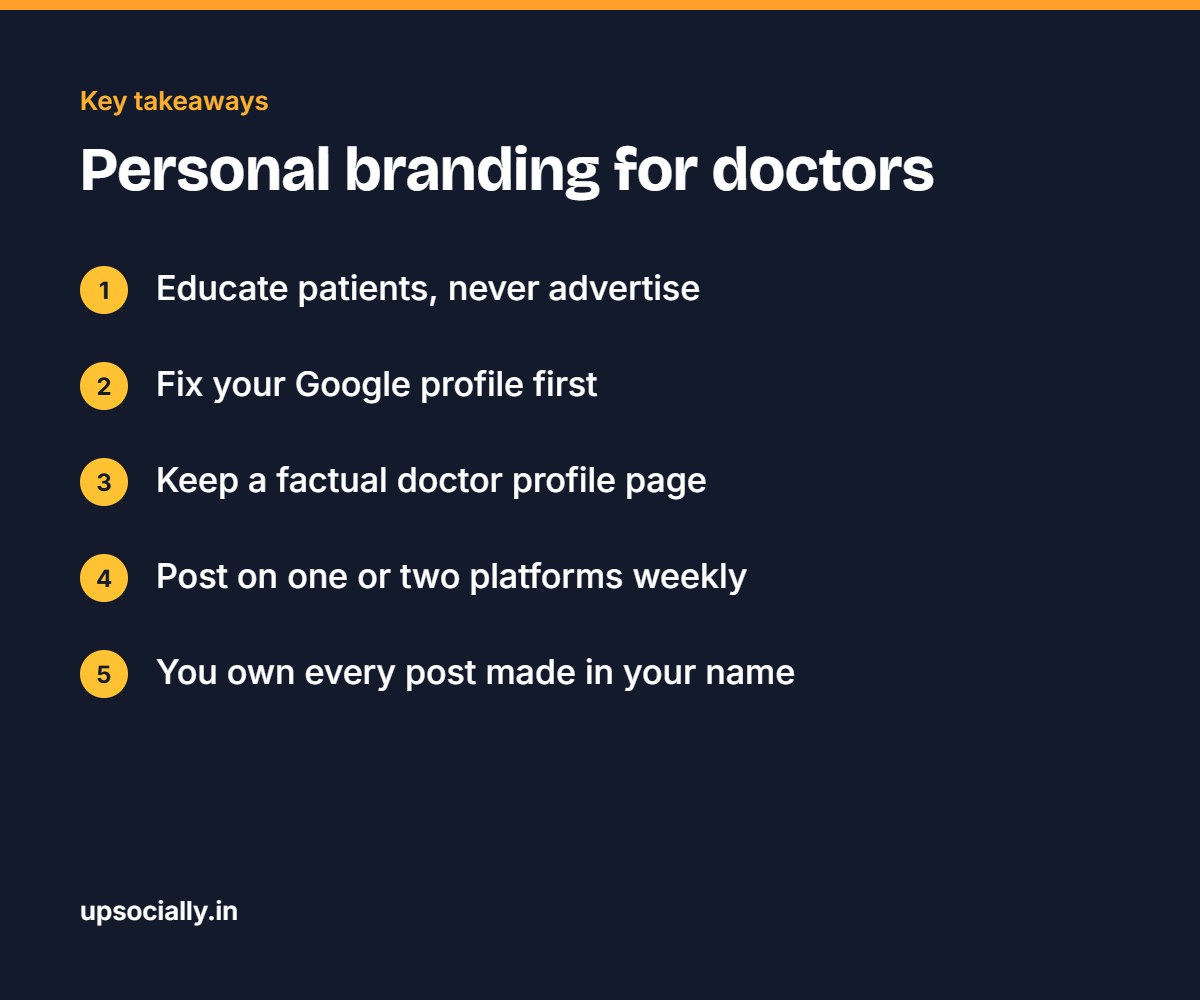
Key takeaways
- A doctor’s personal brand is reputation built through education, accurate information and consistency, not advertising.
- The NMC’s 2026 guidelines allow educational content and factual profiles, but prohibit self-promotion, superiority claims, testimonials and paid endorsements.
- Start with the places patients check first: your Google profile and a doctor profile page.
- Choose one or two platforms and post useful content every week.
- You are responsible for anything published in your name, even if an agency or team posts it.
What personal branding for doctors means in 2026
On 6 October 2026 the National Medical Commission issued its Guidelines on Ethical Advertising and Public Communication, effective immediately. They prohibit doctors from soliciting patients or promoting themselves, but they explicitly allow health awareness work, educational content and media talks in a doctor’s own name (Medical Dialogues summary).
So personal branding for doctors is not about selling. It is about making sure that when a patient or a referring colleague looks you up, they find clear, accurate and helpful information about who you are, what you treat and how you think. Here is the line in practice:
| Generally fine | Not allowed |
|---|---|
| Explaining a condition, test or treatment option | “Best”, “No.1” or “100% success” claims |
| A factual profile with qualifications, specialty and timings | Advertising your success rates or patient numbers |
| Talks on TV, radio or YouTube in your own name | Promotional patient testimonials and before-and-after photos |
| Health awareness campaigns and greetings without promotion | Discounts, free procedures or fear-based messaging |
| Publishing case studies in reputed medical journals | Endorsing drugs, devices or products, even unpaid |
| Clearly labelled AI-assisted educational content | Fake followers, bought reviews or AI-made patient stories |
For the full rulebook, read our guide to social media rules for doctors in India. The steps below assume you will stay inside it.
Step 1: define your focus and who you help
A strong personal brand is specific. “Consultant orthopaedic surgeon” is a job title. “Knee and sports injury specialist who helps active adults get back to running” tells a patient whether you are the right doctor. Write down three things: the conditions you most want to be known for, the patients you see most, and the questions they ask you every week. Those questions become your content plan.
Step 2: get your Google profile right
For most doctors, the first impression happens on Google. If you run a clinic, claim and complete your Google Business Profile with accurate timings, address, phone, specialty and photos of the clinic. If you consult at a hospital, check that the hospital’s listing and your name show the same details. Respond politely to reviews without discussing any patient’s case, and never buy or incentivise reviews; the 2026 guidelines specifically ban manipulated ratings.
Step 3: build a doctor profile page or website
A profile page is where search, social media and referrals all lead. Include your name, qualifications, registration number, specialty, the conditions you treat, where and when you consult, and how to book. The NMC treats a factual directory of doctors’ names, qualifications, specialties, registration details and availability as patient information rather than promotion, so keep the tone factual. Add a few educational articles answering common patient questions. If you need help, see our healthcare website development service.
Step 4: choose one or two platforms
- LinkedIn: best for referrals from GPs and other specialists, hospital leadership and academic work. Share CME learnings, conference talks and published papers.
- Instagram: good for short patient-education Reels and carousels, especially for specialties patients research visually, such as dermatology, fertility, physiotherapy and dentistry.
- YouTube: ideal for longer explainers that patients search for, such as “what happens during a knee replacement” or “IVF process step by step”.
- WhatsApp Business: for appointment queries from patients who already know you, not for broadcasting promotions.
Two platforms run consistently will do far more than five you update once a month.
Step 5: publish education, not promotion
The safest and most effective personal branding for doctors is simply good teaching. Rotate four content themes:
- Answers: the questions patients ask you every week, answered in under a minute.
- Myths: common misconceptions in your specialty, corrected with evidence.
- Prevention: early warning signs, screening ages and lifestyle advice.
- What to expect: how a consultation, test or procedure works, so patients feel less anxious.
Leave out offers, outcome promises, patient stories and comparisons with other doctors. Add a short line that the content is for general information and not a substitute for a consultation.
Step 6: use video and media appearances
Video builds trust faster than any other format because patients see how you explain things. Record short clips in your consultation room with good light and clear audio, add captions, and speak in the languages your patients use. The NMC guidelines also allow talks on TV, radio and electronic media in your own name and designation, as long as they don’t promote your hospital or practice. Say yes to local health shows, podcasts and webinars on topics you know well.
Step 7: build peer and academic credibility
Referring doctors trust what they see in professional settings. Present at CMEs and conferences, publish case studies in peer-reviewed journals, write for medical association newsletters and teach residents. Share these on LinkedIn as learning, not as achievements, and keep patient details anonymised.
Step 8: protect your reputation online
Search your own name every month. Correct outdated listings on Google, hospital websites and doctor directories. Reply to reviews briefly and professionally, without confirming that anyone is your patient, and take detailed complaints offline. Never pay for followers, likes, reviews or rankings, and avoid any platform that sells paid placement above other doctors.
Step 9: work with a team or agency safely
Most busy doctors need help with editing, posting and design. That’s fine, but the 2026 guidelines say using a third party does not remove your responsibility. Check that your agency:
- Is not paid per patient, per appointment or in any way linked to patient referrals.
- Gets your approval on every post published in your name.
- Labels AI-generated or AI-altered content and never creates synthetic testimonials or patient images.
- Keeps claims factual and removes anything that reads like an advertisement.
A 90-day plan to start your personal brand
| Days | Focus |
|---|---|
| 1–30 | Define your focus, fix Google and directory listings, publish a factual profile page, set up one or two social profiles with a clear bio. |
| 31–60 | Write 20 common patient questions, record answers in batches, post two to three times a week, and publish two educational articles. |
| 61–90 | Add one longer YouTube explainer, share a CME or conference learning on LinkedIn, pitch one local media or podcast talk, and review what patients and colleagues mention. |
Mistakes to avoid
- Posting patient “success stories” or before-and-after photos, even with consent.
- Calling yourself “the best”, “No.1” or “most experienced” in your city.
- Running paid ads that sell your own services with your photo.
- Endorsing supplements, skincare or devices in videos.
- Copying trending audio and formats that make medical topics look trivial.
- Letting a team post in your name without your review.
Personal branding for doctors works when patients and peers find the same consistent, helpful picture everywhere they look. For the wider picture, read our guides to digital marketing for doctors and social media rules for doctors in India, or see our healthcare social media marketing service and healthcare marketing FAQs.
Frequently Asked Questions
Is personal branding allowed for doctors in India?
Yes, if it is built on education and accurate information rather than self-promotion. The NMC’s 2026 guidelines allow doctors to share health awareness content, speak in the media in their own name and keep factual profiles, but they prohibit soliciting patients, superiority claims, promotional testimonials and paid endorsements.
Can doctors post on Instagram and YouTube?
Yes. Doctors can post educational content that explains conditions, treatments and prevention. Avoid before-and-after photos, patient success stories, offers and claims such as “best” or “100% success”, and label any AI-generated content.
Can a doctor use their photo on social media?
Your profile photo and educational videos where you explain a topic are part of normal public communication. What the NMC guidelines restrict is using your photograph in advertising that amounts to self-promotion, such as promotional banners or paid ads that sell your services.
Which platform is best for a doctor’s personal brand?
For most specialists, a Google Business Profile and a doctor profile page come first, because patients search before they book. Add LinkedIn for referrals and peer credibility, and Instagram or YouTube for patient education. Two platforms done consistently beat five done occasionally.
Can an agency manage a doctor’s personal branding?
Yes, but you remain responsible for everything published in your name. Under the 2026 guidelines, an agency cannot be paid in a way linked to the number of patients it brings in, and it cannot do on your behalf anything you are not allowed to do yourself.
How long does it take to build a personal brand as a doctor?
Expect around 90 days to set up your profiles and publish a steady base of content, and 6 to 12 months before search visibility, referrals and recognition build noticeably. Consistency matters more than volume.
UpSocially Team
Written by the UpSocially team in Bengaluru, a group of performance marketers, designers and developers who plan, build and run campaigns and websites every day. UpSocially is a performance marketing and website development agency working with healthcare, real estate, construction, education and B2B brands across India. We write from the campaigns and websites we plan and build, and we check regulated-industry articles against official sources.
Last reviewed: 16 November 2026
A personal brand patients trust
We set up doctor profile pages and Google profiles, script and edit patient-education videos, and manage social media inside the NMC 2026 guidelines, with every post approved by you. Tell us about your practice.