
Free spa marketing audit
Is your spa getting found online?
Get a free spa digital marketing audit. We'll check your Google Maps ranking, website, reviews, ads and WhatsApp replies against spas near you, and send a clear plan.
Get my free spa audit on WhatsAppSee how we market spas- Free, no obligation
- Reply within 4 working hours
- Plan made for your area
Key takeaways
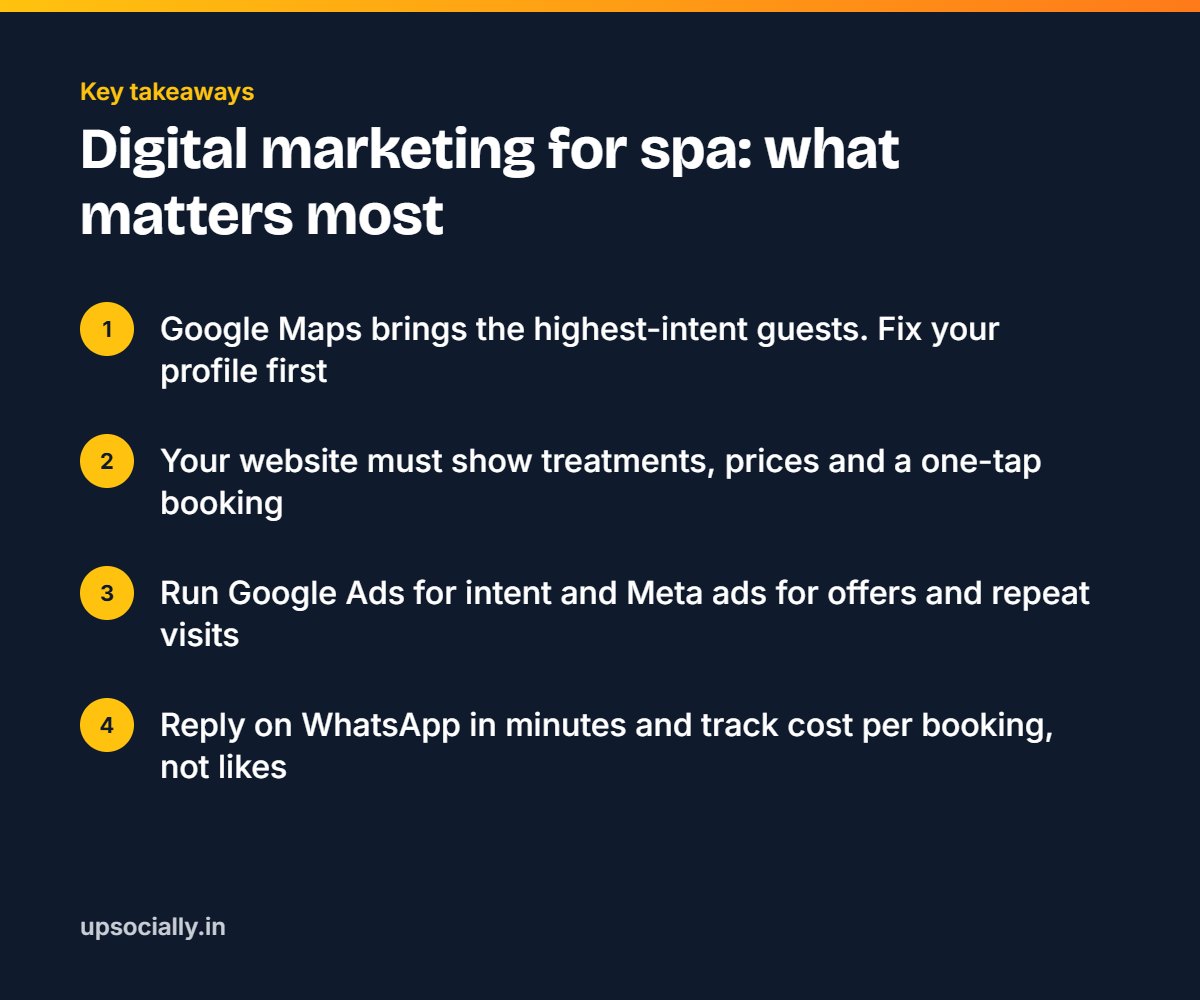
- Start with Google Maps. It brings the guests most ready to book, and most spas have big gaps in their profile.
- Your website is where Google, ads and AI assistants check you. Show treatments, prices, therapists and a one-tap booking.
- Use Google Search ads to catch intent and Meta ads to promote offers, fill weekday slots and bring guests back.
- Reply on WhatsApp within minutes, ask every guest for a review, and judge every channel by cost per booking.
What Is Digital Marketing for Spa Businesses?
Digital marketing for spa businesses is the use of online channels to get found by people nearby, earn their trust and turn them into booked and repeat guests. The main channels are Google Maps (your Google Business Profile), your website, SEO, Google Ads, Meta ads on Instagram and Facebook, WhatsApp, online reviews and listing sites.
It is different from general spa marketing in one important way: everything can be measured. You can see how many people called from your Google listing, how many tapped WhatsApp on your website and what each booking cost from each ad. That lets you move money from what looks good to what actually fills rooms.
How Guests Find and Book a Spa Online
Before choosing channels, map the journey your guests take. Each stage has one job and one number to watch.
| Stage | What the guest does | Channels that matter | Number to watch |
|---|---|---|---|
| Discover | Searches “spa near me”, a treatment or an area, or sees a Reel | Google Maps, Google Search, Instagram | Profile views and search impressions |
| Compare | Checks photos, prices, reviews, hygiene and location | Google profile, website, reviews | Website visits and direction requests |
| Enquire | Calls, taps WhatsApp or fills a form | Call button, WhatsApp, booking page | Calls, WhatsApp chats and forms |
| Book | Confirms a slot, sometimes pays an advance | WhatsApp, booking software | Bookings and booking rate |
| Return | Comes back, buys a package, refers friends | WhatsApp, Instagram, memberships | Repeat rate and reviews |
Most spas spend on the first stage, posting on Instagram or running boosts, while losing guests at the third. A slow reply on WhatsApp or a missing price list wastes everything you paid to get the enquiry. Fix the leaks from the bottom up.
1. Google Business Profile and Local SEO
For most spas, the Google Business Profile is the single most valuable channel for spa bookings. It shows in Google Maps and in the local results at the top of search, exactly when someone nearby is looking.
- Choose the right primary category. Pick the most specific category that describes your main service, such as Day spa or Massage spa, and add secondary categories only for services you really offer.
- List every treatment with a price or starting price. Use the Services section and the names guests search for: deep tissue massage, Abhyanga, couples spa, foot reflexology, body polish.
- Upload real photos often. Reception, treatment rooms, the steam room, washrooms and your team in uniform. Hygiene and comfort are what guests look for.
- Keep hours, phone and booking link accurate. Add a WhatsApp or booking link, holiday hours and accessibility details.
- Post weekly. Offers, new therapies and festive packages keep the profile active.
- Keep your name, address and phone identical on your website, Justdial, Instagram and every listing.
Rankings in Maps depend mainly on relevance, distance and prominence, so you will always rank best close to your spa. To reach more of your city, open more locations or build area pages on your website, never fake addresses. Our FAQ on ranking a spa on Google Maps goes deeper.
2. A Spa Website That Turns Visits Into Bookings
Many spas skip the website and send everything to Instagram. That costs them. Google uses your website to understand what you offer, ads need a landing page that matches the ad, and AI assistants such as Google’s AI Overviews and ChatGPT read websites, not Instagram grids, when they recommend places.
A spa website does not need to be big. It needs to answer the questions guests ask before booking:
- Treatment menu with duration and price, or a clear “starting from” price.
- Real photos of rooms and facilities, not stock images of models.
- Therapist training or certification, hygiene practices and what to expect on a first visit.
- Location, parking, timings and how to get there.
- A sticky WhatsApp button and a booking page that works in under a minute on a phone.
- Policies: cancellation, advance payment, gift vouchers and packages.
Add LocalBusiness structured data using the schema.org type DaySpa with your address, hours, price range and services, so search engines and AI tools read your details correctly. Keep pages fast: most of your traffic will be on mobile data.
3. SEO for Treatments, Areas and Questions
Once the basics are right, SEO grows the bookings you do not pay for per click. Three kinds of pages work for spas:
- Treatment pages: one page each for your main therapies, such as Swedish massage, deep tissue, Abhyanga, Shirodhara, couples spa and body scrubs. Explain benefits, duration, price and who it suits.
- Area pages: if you serve several neighbourhoods or have branches, a page for each with directions and local landmarks. Do not create pages for areas you do not serve.
- Answer pages: short, direct answers to questions guests ask, such as “What should I wear for a massage?” or “Is Shirodhara safe during pregnancy?”. These also help you appear in AI answers.
Write in plain language, add your own photos, and link each page to booking. SEO takes three to six months, so start it alongside ads, not instead of them.
4. Google Ads for Spas
Google Search ads put you at the top when someone searches with clear intent, such as “couples spa package Koramangala” or “Ayurvedic massage near me”. They can bring bookings within days.
- Group keywords by treatment and occasion, not one big ad group. Send each group to the matching treatment page.
- Use a tight radius around your spa. Most guests travel only a short distance for a massage.
- Add negative keywords from day one: jobs, salary, training, course, academy, franchise and any adult-intent searches. Review the search terms report every week.
- Use call and location assets so people can call or get directions from the ad.
- Track bookings, not clicks: calls over 60 seconds, WhatsApp taps and form submissions as conversions.
Google restricts ads it considers sexual content. Legitimate spas can advertise, but your ad text, images and landing page must be clearly professional. Read Google’s sexual content policy before launching, and see the wording table in our spa marketing guide. Not sure whether Google or Meta should come first? Read Google Ads vs Facebook Ads.
5. Meta Ads and Instagram
Instagram and Facebook are where people discover a spa they were not searching for, and where they remember you between visits. Use them for three jobs:
- New guests: click-to-WhatsApp ads with a clear first-visit offer, targeted to a few kilometres around your spa. A WhatsApp chat usually converts better than a lead form, because guests can ask questions straight away.
- Quiet slots: weekday and afternoon offers, couple packages and festive gift vouchers for Diwali, Valentine’s Day and Mother’s Day.
- Repeat visits: retargeting people who visited your website or messaged you, and customer lists of past guests who agreed to hear from you.
For organic content, short Reels of the space, a therapist explaining a treatment, before-and-after foot or facial care, and calm behind-the-scenes clips work better than generic quotes. Keep every image professional, because Meta also limits ads it sees as sexually suggestive.
6. WhatsApp: Where Bookings Are Won or Lost
In India, most spa enquiries end up on WhatsApp. Speed and clarity here decide whether you get the booking.
- Use WhatsApp Business with a catalogue of treatments and prices, quick replies and labels such as New enquiry, Booked and Follow up.
- Reply within minutes during working hours. Set an away message with your booking link for after-hours enquiries.
- Ask two questions, not ten: preferred treatment and date and time. Then offer two slots.
- Send a reminder the day before and a thank-you with your review link after the visit.
- When volumes grow, move to the WhatsApp Business API with a provider for automated replies and reminders. Customers must opt in, and messages you start need Meta-approved templates.
7. Reviews and Reputation
Reviews influence both your Google Maps ranking and the guest’s decision. Spas live and die by trust: hygiene, professionalism and comfort.
- Ask every guest at checkout with a QR code at reception and a WhatsApp message with your review link.
- Reply to every review within a day, including the negative ones, calmly and without sharing details of the visit.
- Never offer discounts or gifts for reviews, buy reviews or post them yourself. Google’s policies prohibit it, and fake reviews can get removed or flagged.
- Show your best reviews on your website and Instagram highlights.
8. Listings, Directories and Deal Apps
Justdial, Sulekha, Bing Places, Apple Maps and local directories still send enquiries and help your name, address and phone stay consistent across the web. Claim and complete the main ones, and keep details identical everywhere.
Deal apps and group-buying offers can fill rooms quickly, but they attract price shoppers. Use them for quiet slots only, and turn those guests into regulars with a good first visit and a WhatsApp follow-up.
What to Track Every Month
Good spa marketing online comes down to a handful of numbers. Review them monthly, by channel.
| Metric | What it tells you | Where to find it |
|---|---|---|
| Enquiries by channel | Which channels bring people who want to book | Google profile, call tracking, WhatsApp labels, GA4 |
| Booking rate | How well your team turns enquiries into bookings | Booking software or a simple sheet |
| Cost per booking | What each paid booking costs, by campaign | Ad spend divided by bookings from that campaign |
| Average ticket | Whether you attract package and premium guests | Billing or POS |
| Repeat rate | How many guests return within 90 days | Booking software or CRM |
| New reviews and rating | Your reputation trend | Google Business Profile |
A simple example shows why booking rate matters. Say ads bring 100 WhatsApp enquiries a month. If your team books 25 of them, each booking costs four times the cost of an enquiry. If faster replies lift that to 40 bookings, the same ad budget brings 60% more guests. Often the cheapest growth is in your replies, not your ads.
How to Split Your Digital Marketing Budget
There is no universal figure, but this is a sensible starting split that we adjust after the first four to six weeks of data.
| Stage of your spa | Where to focus | Starting split |
|---|---|---|
| New spa (first 6 months) | Google profile, website, Google Search ads, launch offer on Meta | About 60% Google, 40% Meta |
| Established single spa | Search ads for high-value treatments, Meta for quiet slots, SEO | About 50% Google, 35% Meta, 15% content and SEO |
| Multi-branch or chain | Branch-level Google profiles and area pages, brand campaigns, retention | Set by branch, with a shared retention budget |
Keep a separate one-time budget for photos, the website and setting up tracking. Without tracking, you cannot tell which part of the budget is working. For typical costs, see digital marketing cost in India.
Trust and Compliance: Keep Your Spa Safe Online
- Professional visuals and wording in every ad, post and page, so platforms approve your ads and guests feel safe.
- Licences and registrations required by your city and state, kept current, with your registered business name used consistently online.
- Guest data such as phone numbers and preferences collected with consent and handled under India’s Digital Personal Data Protection Act.
- Honest offers with clear terms, validity and what is included, so there are no disputes at the counter.
Doing It Yourself vs Hiring a Spa Marketing Agency
A single spa owner can handle the Google profile, WhatsApp replies and Instagram with a few hours a week. Ads, tracking, SEO and websites take more skill, and mistakes with spa ad policies can get accounts restricted.
If you hire help, ask any agency these questions:
- How will you measure success? The answer should be bookings and cost per booking, not likes or reach.
- Have you handled spa ad approvals on Google and Meta before?
- Who owns the ad accounts, website and Google profile? It should always be you.
- What will you do in the first 30 days, and what report will I get each month?
Digital Marketing for Spa Businesses by City
Competition, prices and guest expectations differ by city. A day spa in Bengaluru competes on convenience near tech parks, a Goa spa depends on tourists searching before they arrive, and Chennai guests often look for Ayurveda and family-friendly wellness. See our city guides for spas in Bangalore, spas in Chennai and spas in Goa, and our salon and spa marketing FAQs.
Final Thoughts
The spas that win online are rarely the ones with the biggest budgets. They are the ones that are easy to find on Google Maps, look clean and professional, show their prices, reply fast on WhatsApp and ask every guest for a review. Get those right first, then add ads and SEO, and measure everything in bookings. That is what digital marketing for spa owners should deliver.
Frequently Asked Questions
What is digital marketing for spa businesses?
Digital marketing for spa businesses is the use of online channels such as Google Maps, a website, SEO, Google Ads, Meta ads, Instagram, WhatsApp and online reviews to get found by nearby customers, earn their trust and turn them into booked and repeat guests.
Which digital marketing channel works best for a spa?
For most spas in India, Google Maps (Google Business Profile) brings the highest-intent guests, because people searching “spa near me” are ready to book. Add a fast website with prices and booking, Google Search ads for treatment searches, and Meta ads and WhatsApp to fill quiet slots and bring guests back.
How much should a spa spend on digital marketing?
There is no fixed number. It depends on your city, competition, ticket size and number of rooms. Start with a test budget for one or two channels, track cost per booking for 4–6 weeks and scale what pays back. See our guide to digital marketing cost in India.
Why do Google and Meta reject spa ads?
Both platforms restrict ads that look sexually suggestive. Spa ads get rejected for revealing images, close-up body shots or wording that hints at adult services. Use calm, professional photos, name treatments clearly and keep landing pages consistent with the ad.
How long does digital marketing take to work for a spa?
Ads and WhatsApp follow-up can bring bookings within days. Google Maps improvements usually show in a few weeks, while SEO for treatment and area pages builds over three to six months.
How can a spa get more Google reviews?
Ask every happy guest at checkout with a QR code or a WhatsApp link to your review page. Google does not allow offering discounts or gifts in exchange for reviews, so ask everyone, reply to every review and never buy or write reviews.
Is Instagram enough to market a spa?
No. Instagram builds trust and keeps you top of mind, but most new guests find spas through Google search and Maps. Use Instagram alongside a strong Google profile, a website and WhatsApp booking.
Should a spa hire a digital marketing agency?
If you lack time or in-house skills for ads, SEO and tracking, an agency that knows spa ad policies and local SEO can save months of trial and error. Ask for a plan measured in bookings and cost per booking, not likes or impressions.